Feeds:
Posts
Comments

Posts Tagged ‘spirituality’

Master Your Anger

Sin is crouching at the door . . . and that door is anger. I know this to be true. I have seen the destructive power of angry explosions. I have seen them both against me and through me. Anger is a storm with no boundaries. Anger is unproductive. Anger is an invitation to mistakes; mistakes than cannot be easily corrected. Anger writes in indelible ink.

Genesis 4:6-7
 Then the Lord said to Cain, “Why are you angry? Why is your face downcast? If you do what is right, will you not be accepted? But if you do not do what is right, sin is crouching at your door; it desires to have you, but you must rule over it.”

Anger is a reaction to circumstances and shows the lenses through which a person experiences that moment. Anger usually indicates that there were different expectations. We choose whether we hold on to this anger, this beast, or allow it to be tamed.

My bi-polar mother could not control her anger nor could she it as out of proportion to the actions. It made life very difficult and quite honestly, I found myself lying a great deal to avoid the explosions. I tuned in to the body language of a simmering storm. I became an adept.

But why then, when it was me that exploded toward my children, could I not see it as clearly. How did I recreate that monster?

Some say that anger can be good, that it clears the emotional storage bin. But I don’t have that kind of confidence in anger’s potential for good. It has brought no such cleansing.

My cleaner is tears. They wash my soul. And I am grateful for a God who collects them (Psalm 56:8).

Read Full Post »

Painted by Hans Baldung Grien
16th Century

In a previous post, I spent some time thinking about the idea of choices and boundaries for human in the Garden of Eden (a decidedly perfect environment) and yet, within that garden stood a tree with forbidden fruit. Human had to choose whether to honor God’s boundary (“do not eat”) or not. Now, it appears another kind of choice was there as well, whether or not to believe the “crafty serpent.”

Genesis 3:1aNow the serpent was more crafty than any of the wild animals the Lord God had made. He said to the woman . . .

Another thing occurred to me today. Why are so few people concerned with the concept of a serpent that could a) talk and b) interact with human? Some might reason that this was possible because it was really Satan in the guise of a serpent, but still, a talking critter is talking critter. And apparently, human (Adam or Eve) was not particularly surprised by this talking faculty either. Is it possible then that other animals or creatures in the Garden could communicate? I know, that sounds fantastic. (Is that any more fantastic than the idea of a Garden with only two people who named all the animals and walked around naked?) After all, the Garden is not supposed to be Dr. Doolittle’s domain. And yet, isn’t it fun to consider? Perhaps this ability to communicate with other species was lost to us in the “fall.” In some ways, it makes perfect sense that we make up so many stories about talking animals in our children’s stories, fairy tales, and movies. If only, we think, if only my dog could tell me what he really wants. If only my cat would explain why she is so angry with me. And so on.

A few years ago, Carolyn Parkhurst wrote a novel called The Dogs of Babel, in which a man’s wife dies after falling from a tree and the only witness was their dog. The man, a linguistics professor, is so embroiled in grief that his only hope for recovery is to get the truth about his wife’s death from the dog . . .  by teaching him how to talk. To me, that story captured the longing of inter-species relationships.

But, enough about talking animals. What I really wanted to investigate was the logic of the serpent for challenging humans. I believe he really wanted to undermine God’s authority and the best way to do that was by usurping the human role in Eden. The serpent, as a creature of the Garden, had been placed under the authority of human (see Genesis 1:28) just like all the other animals and creatures. To me, this is the reason the serpent was so crafty. He had a bone to pick with Creator and for this reason, he tricked humans, those most beloved of God. Otherwise, why bother?

This breakdown of the chain of command works in today’s world too. What better way to break things up than to hit the “middle manager.” In this way, the organization (or the church) suffers both up and down the ladder. Those below the middle manager begin to distrust that person’s reliability while the administrator above is seen as a poor leader, unworthy of respect. By encouraging human Adam and human Eve to break the boundaries of the Creator, the serpent broke himself free as well. The serpent’s goal was and still is bigger than human.

Evil has an agenda that is beyond mere “search and destroy” missions of human beings. Ephesians 6:12 says “For our struggle is not against flesh and blood, but against the rulers, against the authorities, against the powers of this dark world and against the spiritual forces of evil in the heavenly realms.” Same for them.

What is my role then today? See the big picture. Believe in the boundaries of God. Believe in the reality of a secret agenda of evil. Trust the sovereignty of God.

Read Full Post »

I looked it up, the word, beatitude. It actually comes from the Latin word, beātitūdō, which means perfect happiness. I was already suspect with the idea of “perfect,” not to mention the leap to my struggle with perfectionism. Add the expectation of happiness, a most elusive beast [it’s right up there with joy], and I feel like the entire premise is a prescription for failure.

Matthew 5:1-3a
Now when Jesus saw the crowds, he went up on a mountainside and sat down. His disciples came to him, and he began to teach them. Blessed are . . .

Of course, it gets worse before it gets better. Most people have the general understanding of the beatitudes. They know it’s a list of blessings based on a series of paradoxical statements. In other words, be perfectly happy when you are poor in spirit, mourning, meek, hungry for righteousness, merciful, and pure in heart while peacemaking and being persecuted. Now, if that doesn’t make you want to jump up and follow Jesus, what will?

I’m only kidding, of course. But really, the beatitudes feel like the high end of understanding and following Jesus. Despite professing the Christ for over thirty years, I break out in a sweat when I have to revisit the beatitudes. They seem to uncover me or reveal me in a way that nothing else in scripture does. I feel like I need to go to a meeting, stand up and say, “Hi, I’m Irmgarde, and I’m not living out the beatitudes.”

You know, the implication is that this was the summary teaching, the preview of everything that came later. Jesus ultimately walked out these seven verses [Matthew 4:3-10] in the next three years of his ministry. And all the while, he’s saying, this is the way despite what you may think or see. Here is the real freedom. Here is answer to what it means to be fully human.

Let’s all pause and think about that today.

Read Full Post »

Of course, we know why a lot of them followed Jesus. He was healing the sick, and at the beginning of his mission/ministry, he was healing them all. He was a sensation! Who wouldn’t follow? Don’t we do the same today? Don’t we follow the wondrous . . . the unbelievable . . . the news worthy . . . the tragedies . . . and the inexplicable?

Matthew 4:24-25
News about him spread all over Syria, and people brought to him all who were ill with various diseases, those suffering severe pain, the demon-possessed, those having seizures, and the paralyzed; and he healed them.Large crowds from Galilee, the Decapolis,Jerusalem, Judea and the region across the Jordan followed him.

If Jesus was doing the same thing today that he was doing back then, he wouldn’t just have a few hundred or thousand following, he would have millions through the Internet and media. It would be a real circus.

He had only just started his ministry according to Matthew. He was making the circuit around Galilee, stopping into various synagogues along the way and teaching about the kingdom of God being near and close at hand. (It was thirty square miles.) He had headed back home to Nazareth first, got shut out of his home church and then headed to Capernaum (via Cana) where his reputation both followed and preceded him. His notoriety started heating up pretty fast.

Currently, we’re in Olympics fever from London, and I marvel as I watch the various athletes exhibit their best efforts while being followed by a slew of reporters and cameramen. There are remote cameras following them above the water as well as along the track. There are satellite cameras and there are long lenses poking out from every corner. Every movement, every tear, every laugh or smile, is caught on camera. Every win, whether by a long shot or a hair’s breadth, is captured.

Can you imagine the cameras capturing the healings of the Christ? Who would interpret? Who would be the pundits? Who would get the first interview? What would the witnesses say? How long would the healed person be followed around by reporters, perhaps looking for a fake? Where would Jesus go to avoid the constant barrage of both the needy people as well as the rubber-neckers? Where would Jesus go to bypass the media? And who would know the truth? Would we believe what we saw on camera? Would we follow Him on Fox News or NPR? Would we snatch up People magazine to see the pictures of someone rising from the dead? Or would we pick up the Inquirer in the grocery line that exposes Jesus as a fraud?

What keeps me following Him today? Is it the scripture stories? Is it the fellow believers? Is it my circumstances, once dire, and now more stable? Is it the miraculous or the mundane? Is it the charismatic pastor or the throbbing music beat at church?

There were times in my journey when I longed to see and experience more of this Jesus/Holy Spirit, not unlike the fantastic descriptions in scripture, written and retold, and then sustained by faith and repetition through the centuries. I wanted a miracle! Each decade in the 20th century has brought various phenomena, from speaking in tongues, to falling in the spirit, to laughing in the spirit, to prophetic utterances, to spontaneous healings, to golden dust falling on the faithful. Each manifestation brought thousands into a place and time, who like the followers of Jesus, wanted to see, hear, and feel, a tangible presence of God. And although it was often fleeting, many were not disappointed. At least, not at first. But then the phenomena passed, the touched people moved on, the crowds thinned, and we looked for the next manifestation.

But who/what did we follow? The miracles or the person? Who did they follow? The miracles or the person?

And all the while. The kingdom was near and still is. The kingdom is within us; in our midst. [Luke 17:21] Here. Everything needed is right here. Right now.

Read Full Post »

Icon: John the Baptist

To wash ceremonially in ancient Jewish times was to participate in a mikveh (or mikvah). For rituals, particularly washing from impurity, required “living” or flowing water such as a river or mikvot (the mikveh place) fed by a natural spring. It constituted the washing away of the old impurities and to mark the beginning of the new.

Matthew 3:1-2,
In those days John the Baptist came, preaching in the wilderness of Judea and saying, “Repent, for the kingdom of heaven has come near.” . . .  “I baptize you with [or in] water for repentance. But after me comes one who is more powerful than I, whose sandals I am not worthy to carry. He will baptize you with [or in] the Holy Spirit and fire.

John the Baptist treated sin as the greatest impurity of all and called everyone who wanted a new start to celebrate a mikveh with him, right there in the desert, in the river Jordan. While priests, via the regulations in the Torah and other rabbinical writings, performed the mikveh for a variety of circumstances (after sexual relations for men, a menstrual cycle for women, after the birth of a child, upon declaring someone healed of a skin disease or leprosy, prior to Yom Kippur, and so forth), this may have been the first time that a mikveh was performed without a traditional priest.

John’s message was clear: prepare the way (prepare yourselves) for the coming Messiah. Release the old and make room for the new.

The water submersion was a ritual meant to mark a moment in time. And yet, John promised another moment, a time that would be marked by something more permanent than water: the Holy Spirit and Fire.

The baptism of the Holy Spirit came after Jesus’s resurrection, the gift was given (and promised) to all believers — the in-dwelling of God [Acts 2]. This in-dwelling changed everything and everyone. We tend to minimize this deeply motivating presence today.

There is so much “Jesus Junk” (Tchotchkes) and pat phrases like “Jesus loves you brother.” But it’s more than that. It’s not just that Jesus loves you; it’s that Jesus is you [Philippians 1:21]. Jesus and the Holy Spirit are one. And once Jesus has been invited to occupy us, then the process of true sanctification begins, fusing me and the Christ. And with sanctification, unnecessary elements must, like chaff, be cast away and in some cases, burned away through experience, pain, persistence of motion, and repetition. We are all intended to “get it.”

The occupy movement from Wall Street to Washington, D.C., has nothing on the potential power and change that comes from the occupation of a human being by the Holy Spirit. This is the most authentic change of all.

Read Full Post »

There are a few stories in scripture about being told to get up and go. Abraham comes to mind [Genesis 12] when God told him to leave Harran and go (who knew where) and Abraham wandered to several places looking for the right one (and even, for a time, into Egypt). When God first spoke to Abraham and Joseph, the “away” was more important than the destination.

Matthew 2:13-14
When they had gone, an angel of the Lord appeared to Joseph in a dream. “Get up,” he said, “take the child and his mother and escape to Egypt. Stay there until I tell you, for Herod is going to search for the child to kill him.”So he got up, took the child and his mother during the night and left for Egypt . . .

God doesn’t always give us the big picture when we’re asked to leave one situation or place for another. In fact, I think the truly Godly adventures come with a pretty good dose of the unknown (may even a flat-out Star Trek mission “to boldly go where no man has gone before). Anytime we leave the familiar for the unfamiliar, there is trepidation and fear. If there wasn’t, then we’re probably not being straight-up about the departure. We’re thinking, I can always go back. Like so many twenty-somethings who are boomeranging back home after college while looking for work, they figure “home” is a good Plan B. But you see, Joseph didn’t have a back up plan. He was totally dependent on that voice inside his head that said “go” and had to hope he’d hear it again when (and if) a time came to return.

Me? I’m always second-guessing my destination. My not-so-private joke is that I prefer “planned spontaneity.” I don’t even like using a GPS because it’s a turn-by-turn description and too hard for me to “see” ahead. Give me a good old paper map any day. (And this is from a tech junkie!)

So, here’s the thing. If God wants me to head to Egypt (symbolically), chances are I’m going to ask for a Fodor’s. Maybe, if I had a really strong guide or someone who’s been there before, I would be more willing to go.

This is where the Body of Christ could really come into the picture. You see, each one has been to one of these Egypts along our way. Right? Even me. Like everyone, I’ve had times and places I didn’t really want to go, but I had to go and despite my proclivities, I didn’t always have a map: I learned through experience. Boy, did I learn. (I’m pretty sure those “Egypt” trips would have been better had I gone willingly; had I gone with trust in the one sending me there.)

That’s the key: I can say or do all kinds of things to avoid Egypt and yet, I end up there anyway–the long way; like the Israelites who had to put in those extra 40 years in the desert because they were unwilling to trust God for the land of milk and honey. They thought they knew better.

I believe I have a certain obligation to go back and tell/show the other ones about the way. I know there are folks still hanging back? Granted, I blazed a pretty loopy trail, but I also got some insights and short-cuts in hindsight.

As I begin this new, and last quarter, of my life, I believe I am being asked to take on a new role.

Read Full Post »

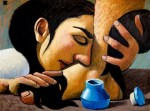
Anointing His Feet 2
by Wayne Forte

Worship, in English, can mean to “declare worth.” That’s comfortable. However, in the original Greek, proskynéō means to kiss the ground while falling prostrate to a superior. When was the last time you fell to your knees before someone or something of such awesome worth or value?

Revelation 22:8b-9
I [John] fell down to worship at the feet of the angel who had been showing them [the prophecies] to me. But he said to me, “Don’t do that! I am a fellow servant with you and with your fellow prophets and with all who keep the words of this scroll. Worship God!”

The angel is saying to John, don’t fall down before me, but fall down before the One God, individually and corporately.

In some ways, the Muslim expression of worship is more in keeping with the intent of the word. Other faiths like the Orthodox denominations, Catholics, and some Eastern religions practice deep bowing and submissive movements. In recent years, some charismatic believers have found their deepest experience of prayer when it is coupled with lying prone, face down.

But most of us have lost the physicality of worship. A high church may still have kneelers (to make the submissive act more agreeable) but generally, the most common form of respect is standing up, not kneeling. Some church congretations stand to sing and some stand to pray while still others stand to hear a gospel passage spoken. There are denominations who do lots of standing up and sitting down (with a kneel or two in between) and there are denominations who have made the standing part optional, for those who find standing difficult.

And yet, for little children, the cliche for night time prayers is on the knees at the side of the bed. Perhaps even that has gone a bit out of style, I don’t really know, although figurines still abound with cherub children, hands sweetly folded, and eyes closed. It’s sweet. It’s innocent. But is it worship? Is it prayer? Is it surrender? Why do we encourage children to do this kneeling bit but not we ourselves?

In more contemporary churches, worship has come t mean the singing part of a service: a series of songs, starting with fast praise and then followed by a gradual slow down into devotional melodies and words of adoration. And repetition has become a sign of a deeper experience.

I’m not putting any of these “expressions” down. I faithfully attend a contemporary church. I’m right in there.

But, if I take any time at all to think about it, I do find most forms of Western worship to be very predictable and perhaps, if truth be told, a bit colorless and watered down. We keep boiling down the experience of worship into the most common denominator. Whether the service is a lively 60 minutes or a filibustering three to four hours, we are no closer to kissing the ground before God in adulation and acknowledgment of a divine presence.

After visiting several churches of the Middle Ages up through the Renaissance periods in Europe, I can understand why they designed them that way: they were attempting to remind us of the enormousness of God and smallness of Human. Whether sitting, standing, or kneeling, a person feels the divergence between self and the vaulted representation of all that is above and beyond. What do we have in the U.S.? Mauve chairs, blue carpet and artificial flower arrangements. Comfort, comfort, comfort, to the eye as well as the buttocks.

Everything is so controlled in our churches. Either it’s a repetitive liturgy or it’s an “order of service” that is constrained by the clock. Even those services not confined to time are confined to set rituals.

How many times have I really felt and expressed my absolute surrender to God, Spirit God, Father God, Holy God? When has my body responded spontaneously to my soul’s understanding? When did I ever put my life in danger and touch the hem of the Master’s cloak or wash His feet with tears and dry them with my hair? When did we moderns lose our ability to relinquish self to the Holy Spirit?

Read Full Post »

« Newer Posts - Older Posts »