Feeds:
Posts
Comments

Posts Tagged ‘trust’

Sometimes it simply comes down to this basic request of God: Teach me! Even the disciples, in all of their travels and time spent with Jesus, still didn’t get it and all they could say was, “teach us.” [Luke 11:1] But of course, in order to learn, I must be open to the information.

WhichwayTeach me how to do Your will,
    for You are my God.
Allow Your good Spirit to guide me
    on level ground, to guide me along Your path. [Psalm 143:10, The Voice]

First of all, I must know and trust the teacher. In Psalm 143, David identifies clearly his relationship to the teacher for it is God alone who has the ability to teach was David needs in that moment. His life is at a cusp, a turning point and David must figure out what to do next. The only course to take is God’s way, but what is it? This is the eternal dilemma of most believers at one point in our walk or another.

Which way? Where next? What next?

And so, I must turn to God and ask for direction or even better (as translated in the voice), ask for instruction to determine God’s will (both this time and the next time and the time after that).

As part of this request, I am hoping for a little extra help in discerning the way. This time, I say, I really don’t know which way to turn, what to say, how to proceed. Guide me, Lord, and as your Spirit guides me from within, use this opportunity to teach me how you work both inside me and outside me.

So often, I find myself on an uphill climb and I sense it’s not the best way to tackle my issue, my understanding. I may even be making things more difficult than they need to be.

I need to stop striving so. I need to stop, right where I am and confess my “control freak” self has taken over the reigns again and I’ve managed to get myself back into a difficult state of affairs. I didn’t pay attention to the Spirit before I started out on this path. I didn’t even bother to “check in.”

Forgive me Lord. Like Sara of old who thought she had to help out prophecy and gave her handmaiden, Hagar, to Abraham that Hagar  might bear a child whose destiny would be to populate the earth. O Sarah, foolish bride, set a great nation in motion that may have never intended to be one.

Each of us set change in motion by our actions, our words, our decisions: sometimes for good and sometimes not.

I let go of the past. I trust in God’s future for me. Teach me about the now of my life.

Read Full Post »

Psalm 143 is filled with urgency and no less in these two verses:

hidingplaceLet the morning bring me word of your unfailing love,
    for I have put my trust in you.
Show me the way I should go,
    for to you I entrust my life.
Rescue me from my enemies, Lord,

    for I hide myself in you. [Psalm 143:8-9 NIV 2011]

I don’t know this kind of urgency very often. From day to day, I live a life of relative ease. There might be emotional upheavals and drama (after all, I have two young adults still living at home with us), but none of these cause me to burrow into the hiding place of God. I do not live in a foxhole as many people do throughout the world today. Instead, for all I know, I may be luxuriating in pot of water on the stove, getting warmer and warmer, but not realizing I am actually dying.

Well, we all are. From day to day, closer each day to some inevitable transformative moment that will take us out of our bodies in an instant or on a journey of pain and disease, a slower but nonetheless equally lethal end. This is part of living, the dying.

There have been several deaths around me of late: husbands of friends, old friends, passing acquaintances, relatives of colleagues, and on and on the list seems to get longer each year. We have a patron who comes into the library every week to look at the local newspaper for one thing only, to check the obituaries. There is always someone she knows, she has lived in this same community all of her life.

Is the shadow of death the only real urgency in a life? Or, is that merely self-serving to the end?

Or, are we to live with empathy for others in their crisis?

No one can sustain the stress of true crisis for an extended time. The body cannot generate enough adrenalin. I could help by if I knew how to envelop this person in need with the love of God, with the touch of authentic human, with the promise of rest. But then, I must really know what it means to shelter in God before I can bring someone else into the hiding place.

Back in my childhood, I was never very good at playing hide and seek. Either my hiding place was too good (and no one could find me so I would come out – who wants to be alone in a hiding place?) or the spot was too easy and I was found right away. Often, I would keep peeking out just to see what was going on around me. Just in case. And of course, this would be another way I would be pulled free from safety.

And there’s the problem, the human tendency to peek. To hide in God works better as a permanent solution, not just in a state of emergency. If I could stay in the hiding place of God, within the Spirit of Christ, my view of the world would be through a completely different lens. I would see more clearly; I would recognize needs in others; I could envelope and invite them in, for the place is large and plentiful. The hiding place of God knows no limits, nor does it include chains. It’s a choice to remain, just as it is a choice to enter.

So, does the hiding place mean I won’t experience urgency and fear and pain? On the contrary, those moments will still happen, I’m sure of it. The difference is in walking out trauma with an ongoing confidence in the Presence: “We are confident that God is able to orchestrate everything to work toward something good and beautiful when we love Him and accept His invitation to live according to His plan” [Romans 8:38, The Voice].

And remaining “in” God. No peeking.

Read Full Post »

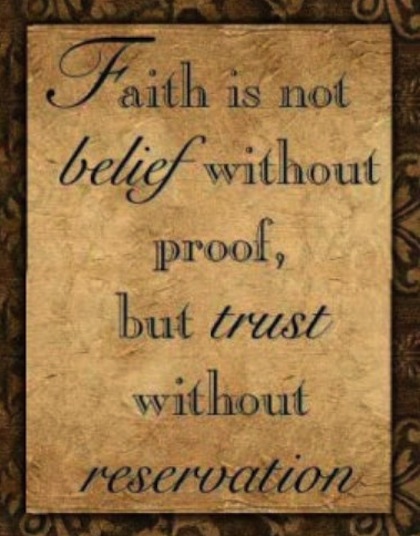
trust2It’s the ultimate question, really. Do I trust God or not? It is a question who’s answer is black or white, yes or no. Any answer close to “maybe” is a no. It is the essence of faith; they work in tandem, they need each other.

Lord Almighty,
    blessed is the one who trusts in you. [Psalm 84:12, NIV 2011]

It is trust that operates outside of the tangible world. Trust is the foundation upon which I can continue forward in the face of trouble, in the face of terror, in the face of sickness or collapse.

Trust and faith are spirit words. They are not driven by circumstances or the weather. When I live in the realm of trust and faith, I am living in the Maker’s world.

Read Full Post »

It is a journey. It has always been a journey. And not just any journey, but a pilgrimage, a long odyssey toward a sacred place.

Paper cut design by Sue Codee

Paper cut design by Sue Codee

Blessed are those whose strength is in You,
    whose hearts are set on pilgrimage,
As they pass through the Valley of Baka [valley of tears],
    they make it a place of springs;
    the autumn rains also cover it with pools.
They go from strength to strength,
    till each appears before God in Zion [dwelling place]. [Psalm 84:5-7, NIV 1984]

In YouVersion notes, the valley of Baka is explained this way: “It was nearly impossible to travel this valley without facing extreme hardship and suffering. That is why the Valley of Baca was named because it literally means “Valley of Tears”. Those who traveled this valley did not find relief until they reached their final destination.”

This is the way of the journey we have agreed to take as followers and believers. We can try to avoid this valley, but dangers abound whether we go through the Valley or around it. For this reason, we are encouraged to go slowly, from strength to strength (and not our own, but God’s) so that tears can be transformed into pools of living water.

My own heart complains of the way still. I know why: I keep trying to travel in my own strength. Like a three year old, I keep demanding to do it myself. Me, me, me. But that’s not the plan at all. And until I surrender and trust God to take care of me in this valley, I will slow my own progress forward.

This truth remains, again and again, I say: it is the paradox of our faith. Die to live; let go to hold; love to repay evil; give to receive.

This is the pilgrimage of the heart.

Read Full Post »

The Lord is my light and my salvation—whom shall I fear?
The Lord is the stronghold of my life—of whom shall I be afraid?  [Psalm 27:1, NIV]

Antelope Canyon, Wikipedia Commons

Antelope Canyon, Wikipedia Commons

Three words drove my prayers from this verse: light, stronghold, and fear.

There are so many different kinds of light but they all get similar results: they transform the appearance of a place or thing by illuminating it. Light pushes back darkness. Light is often a reflection of energy. “God is light, and in God, there no darkness at all.” [I John 1:5] Light reveals things that are hidden. Light is no respecter of persons. Light does not judge, Light is.

And apparently, the presence of Light (the Light) gives confidence against the people, situations or causes I might fear.

A stronghold is best described as a fortified place which has been created as the best (and often the last) line of defense. It is like safe within a bank or a tower within a castle. It is built with defense and safety in mind. This, then, is within me as well. There is a location within me that is protected by the Holy Spirit. This place cannot be breached without permission, an open door or window, opened from within. This is where God’s Spirit dwells in tandem with my own spirit.

But fear is also a strong word and it manifests most often through people. It is unfortunate how often I engage people (and my fear) before I engage my place of strength within or before I shed the Light on the situation. This task is to be done daily, hourly, and even minute by minute. Some people call it centering.

I want to stop “reacting” and simply be fully in the moment and allow that moment to be what it is and me to be who I am in Christ. That’s one of the reasons why it’s called “the peace that passes understanding.” That place is not always apparent if I don’t practice being there.

It is prayer from the place of strength. It is prayer of abandon and trust. It is authentic and transparent.

Read Full Post »

“. . . search your hearts and be silent. Offer right sacrifices and trust in the Lord.” [Psalm 4:4b-5, NIV 1984]

examenBefore anyone starts the blame game, God says look at ourselves first. That’s right. Look at our own hearts because it’s very possible that our circumstances are an outgrowth of our own intentions, our own motives, camouflaged as self-righteousness.

Richard Foster calls it the “prayer of examen,” with two parts: the examen of consciousness and the examen of conscience.

The first asks me to reflect on the “thoughts, feelings, and actions of my day to see how God has been at work . . . and how I responded.” In other words, did God speak through others, through nature, through print, through image, or through circumstance; did I notice? Was I aware of Presence? Did I recognize God and how did I respond? Did I assume it was “not” God and respond with anger, disgust, or judgment? Did I stop long enough to see a need, a sorrow, or a joy? Did I walk through my day with blinders, dark glasses, or binoculars? Did I remember God?

In the second type of examen (conscience), I am to invite the Lord to search my heart to its very depth, but to remember it’s a “scrutiny of love.” Foster states, “without apology and without defense we ask to see what is truly in us. It is for our own sake that we ask these things. It is for our good, for our healing, for our happiness.” This search is done with God, otherwise, we will either justify our actions and find excuses or we will self-flagellate, finding ourselves unworthy. Neither is the point.

And why do we do these examinations? To know ourselves in the light of God’s grace, because it is only from the truth that God can build human as we were always intended to be. “Through faith, self-knowledge leads us to a self-acceptance and a self-love that draw their life from God’s acceptance and love.” (Foster, Prayer: Finding the Heart’s True Home, p. 31)

It is in this process that words and complaints lose their import. Silence is listening.

When understanding dawns, then it is time for right sacrifice. Of course, in the time of King David, sacrifices were specific to sin: a particular animal, a type of grain, a wave, and so on. Each sacrifice was tuned to the sin for which it was offered. But Christ completed that sin offering for us, once and for all. So what is an appropriate sacrifice from us today? The first verse that comes to my mind is  Hebrews 13:15, “Through Jesus, then, let us keep offering to God our own sacrifice, the praise of lips that confess His name without ceasing. ” [The Voice translation] Another is Romans 12:1 [also in the Voice], “Brothers and sisters, in light of all I have shared with you about God’s mercies, I urge you to offer your bodies as a living and holy sacrifice to God, a sacred offering that brings Him pleasure; this is your reasonable, essential worship.”
With these sacrifices, there is an intention then. There has to be, an expression of trust. The path might look something like this: Search, Confess, Sacrifice, Trust. And perhaps, finally, Rest.


Read Full Post »

Psalm 4

trustThis Psalm begins, ” Answer me when I call to you . . . Give me relief from my distress. . . have mercy on me and hear my prayer.”

How often have I cried out in this way: Do Something! Anything!

It’s a kind of command and a kind of plea. The words carry a feeling of desperation as though God has not been answering, has not given relief, has not been merciful, and has not heard any of my prayers. Not true, of course. I know it, but when I am overwhelmed, I feel abandoned by God, alone, and sometimes, even drowning.

In these moments, it is the critical time to stop and think and consider. Am I child of God or not? Have I surrendered my soul to God or not? Do I believe God is in this life of mine or not? No matter what I might have said or done to get myself here, is God still sovereign?

When I am unwilling to pray, I do the greatest damage to myself. I can convince myself that God is not listening, why bother? I can display my life and use it as evidence that God does not answer. I can choose to embrace the arguments of the enemy to my spirit to deafen my ears, to blind my eyes, to dull my senses.

God hears my prayers if I speak them from the heart. Whether they are well spoken or not, desperate or not, flowery or not, God hears because I asked God to be in my life. I accepted the Presence of Christ’s Holy Spirit within me.

When my circumstances seem out of control, I must take a break and change up my image of prayer. It’s like pounding on a locked door, crying and anxious, while God is calling me to turn away, take a walk, take a breath, engage trust. Believe in the “answers” that come from the most unlikely places, that are far more creative than my requests.

I want to stop making my prayers a list of recommended solutions.

Read Full Post »

« Newer Posts - Older Posts »