Feeds:
Posts
Comments

Posts Tagged ‘holiness’

Photo by Andrea Galluzzo

Photo by Andrea Galluzzo

Pollution is a hot topic. The word itself brings up images of oil-slick waters, trash-strewn woods, and smog-filled air. Pollution contaminates, infects, and even poisons. It moves a place, person, or situation from one state to another, and not for good. So, how is the “world” polluting me? What is this world?

Religion that God our Father accepts as pure and faultless is this: to look after orphans and widows in their distress and to keep oneself from being polluted by the world. [James 1:27]

I’m sure there are reams of paper written by clerics and Bible students all over, and I don’t have the time or the inclination to study this topic. I just want to capture a gut reaction.

The world, in Christian circles, always has a negative context: it’s everything from R rated movies to street violence to foul language. It is sexy clothes and sex-filled images “everywhere.” It’s drugs and gambling and porno stores, it’s sexual orientation and alternate lifestyles. Basically, it’s anything that doesn’t line up with the scriptures, according to the folks (and culture and sensibilities) who are reading them. The range of interpretation runs the gambit from the Amish’s “simple life” to left-winger “social justice.”

And there are plenty of scriptures that decry the world in some form or another: John 15:19; John 17:14-16; I John 2:15; Romans 12:2; I Peter 2:11-12; Galatians 3:22.

But perhaps, there’s another way to look at it that might clarify some things. Maybe it’s less important to figure out what the world is doing to us . . . to me . . . and more important to figure out what, in me, is being polluted. Certainly, there are things that I do to my physical body that are not good for me: diet, alcohol, lassitude and inactivity, sleeplessness, disease, etc. But is this my biggest concern or should it be the pollution of my soul? When I invited the Christ spirit to indwell me, then I was (and am) calling forth all that is good to reside within. I am uniting myself with God through Christ. That’s a light, a jewel, a radiance.

What pollutes my spirit? Evil and unproductive thoughts, judgments of others, NOT love, fear, and disdain. It is only the strength of my inner life that can repel the outer influences. Pollution is most dangerous when it seeps into the bone and marrow of a thing, when it permeates the insides. This is where my vigilance needs to be above all. Of course, there will always be controversy on the path that leads to my soul. I know that.

All the same. I’m tired of trying to discern who’s ‘world’ is worst. When I put on all the trappings of being a good Christian, when I followed all the rules, and when I kept myself away from the “appearance of evil,” I don’t believe I was any better off than I am today.

Instead, I want my spirit, my life with the Holy Spirit, to be so robust, that none of those things matter. It is in this way, that I can be neither “in the world” nor “of the world.” And so, I will return to the straightforward words of Jesus himself, “First clean the inside of the cup and dish, and then the outside also will be clean.” [Matthew 23:26b]

Read Full Post »

Print by Julius Schnorr von Carolsfeld's (1794-1872)

Print by Julius Schnorr von Carolsfeld’s (1794-1872)

Jesus knew that the Father had put all things under his power, and that he had come from God and was returning to God; so he got up from the meal, took off his outer clothing, and wrapped a towel around his waist. After that, he poured water into a basin and began to wash his disciples’ feet, drying them with the towel that was wrapped around him. . . . “No,” said Peter, “you shall never wash my feet.”  Jesus answered, “Unless I wash you, you have no part with me.”  [John 13:3-5, 8]

Jesus wanted to make a lasting impression. It’s not like he hadn’t talked about service and humility and lifting up others above oneself. But like so many of the parables and stories, he decided to create a picture, not just with words, but with actions. And yet, only John shares this story. Was it so humiliating? Did they fear the story would belie their claims of Jesus as the Messiah? After all, would the Messiah wash the feet of a mere fisherman? But for John, this was a critical illustration that could not be ignored.

And yet, the symbolic sharing of bread and wine at the meal is excluded by John. Clearly, for him, the foot washing was the most significant. And before that, the anointing of Jesus’s feet by Mary is told in detail. This too is bypassed by the other storytellers, except Luke, who doesn’t even identify the woman.

The significance of leadership and the self-abasement of feet is somehow important.

I never realized how much I under-appreciated my feet until I started having pain in the big toe of my left foot. Sometimes, it was so miserable, I couldn’t walk but a few steps. Every shoe had to pass the pain test before I would leave the bedroom. I tried everything from heat to cold to massage and acupuncture. I started wearing sandals everywhere (and not flipflops because the band would cut directly across the pain spot). Pretty soon, the pain started waking me up at night. Finally, I gave in and went to the doctor. The podiatrist was a little stumped because nothing really showed up in my x-rays or cat scan. In the end, he went ahead and did a bunionectomy even though my baby bunion was not the real problem. I think he just wanted to get in there and look around. It took almost three months to recover full use of my foot again . . . and of course, within a few months, the pain was back, not as acute, but still, there.

The podiatrist was not happy to see me again and said there was nothing more he could do. He gave me a referral to a physical therapist. I delayed that appointment for weeks out of embarrassment. I mean, really, a physical therapist for my toe??? And yet, I finally had no choice. Almost a year after my surgery, I gave in and went to the therapist. He was a really nice guy and I even told him my tale of embarrassment. The prescription was primarily deep massage.

The healing came through touch.

We don’t touch each other very much in our culture. Oh, we may hug and air kiss and we might shake hands or pat someone’s back. But a genuine touch, a focused touch, a touch with intent; now that makes a difference.

I have had massages off and on throughout the years, but only once did I have a massage by a believer who prayed over me throughout the experience. It was literally, life changing.

When Jesus washed the feet of the disciples, I don’t think he poured water out of a measuring cup or use handy wipes. He prepared them for the journey ahead. He healed them from the bottom up. He made them part of himself through touch: intimate and necessary.

I have written and will perform a monologue tomorrow evening at our Good Friday service and at one point, she says, “And if they [sinners and the the sick] were lucky, he would touch them: just so, just so.”

Touch me Lord. Wash my feet. Heal me. Prepare me for the days to come. The journey I have yet to walk.


Read Full Post »

angelic protectionFor he will command his angels concerning you
    to guard you in all your ways;
they will lift you up in their hands,
    so that you will not strike your foot against a stone.
You will tread on the lion and the cobra;
    you will trample the great lion and the serpent. [Psalm 91:11-13]

When I was planning a Lenten devotion series for my church along with my daily responses to the selected scriptures, I accidentally switched the weeks. As a result, the theme of “My God, My Protector” ended up now instead of week two. Funny, I don’t know how it has worked out for anyone else, but this is the week I have needed confirmation of God’s loving protection more than ever.

I am feeling so tenuous and unsure of myself. Every task feels gargantuan and I am unable to get anything done on time, with hours and days racing by with no benchmarks. I guess some of these feelings might be as a result of my previous commitment to the peeling away of outer self and exposing of inner self. In theory alone, it’s a dangerous possibility; but this chaotic reality is unexpected. And why? For this very reason: I am not familiar with this person, this tremor, this confusing cacophony of feelings and thoughts.

So often, I am the bull in a china shop, I plunge into tasks with no subtlety whatsoever and simply trust my knowledge and instincts. But these days, I am on tiptoe, softly treading, unsure of my steps, unsure of the surroundings, unsure of my choices. Everything looks and feels peculiar.

Another devotional book I have been following this season is A Day in Your Presence: A 40-day journey in the company of Francis of Assisi compiled by David Hazard. It’s an old book and a series from the early 90’s, but the entries are very short and hit directly to the matter at hand. Then, in the midst of this study, the new Pope takes on the name of Saint Francis. Why did his choice strike such a chord? I don’t really know; it’s not like I’m Catholic, and yet, the synchronicity of it gave me pause. Something is happening: like a secret revolution.

God is speaking to his people about the Way again. And it’s not big and dramatic and full of signs and wonders. It’s a quiet revolution of the heart. But in that kind of change, it’s important to surrender to the protection of the Holy Spirit. It’s important to trust God in the midst of change. I ask now that God send those angelic messengers to hold me close and prick my spirit to submit to the Presence within.

Amen. Selah (pause and calmly think of that). Amen.

Read Full Post »

waterCome, all you who are thirsty,
    come to the waters;
and you who have no money,
    come, buy and eat!
Come, buy wine and milk
    without money and without cost. [Isaiah 55:1]

It’s really rare that I experience true thirst, perhaps on those rare occasions when I work out or I am outside on a very hot day, but really, water is usually at arm’s length. I live in a society where water is so plentiful (for now), that I can choose other things to quench my thirst, like tea or soda or beer. It’s not like I have to have water.

But if I lived in a parched land, in a desert, I would have a different attitude toward water, I’m sure of it. If I really experienced a drought in my body that only water could refill, I would not be so cavalier about this drink, this fluid that is actually the bulk of my physical being (90%).

That is the kind of desire that would change my faith walk with God. That kind of need and craving for the things of God, for the Presence of the Holy Spirit, for the quenching power that only God can give. If I wanted God the way a truly thirsty person wants water, then I would have fullness. I would recognize God more clearly; I would hear God’s voice; I would “feel” God.

Truly, I believe it.

Instead, I continue in this rather off-hand existence with God. It’s simply not intentional in my surrender.

Don’t misunderstand me. I get thirsty for God. And I drink and I am, for that time, aware of God’s Presence and amazed by the wonder. But then, I grow complacent and dilute the drink. Funny, right? The idea of diluting “water” with other things? But it is so.

Lord, I want to drink of you this day.

Read Full Post »

prayerr“Leave her alone,” Jesus replied. “It was intended that she should save this perfume for the day of my burial.You will always have the poor among you,but you will not always have me.” [John 12:7-8]

Priorities. Sometimes, that can be a the problem while serving others in the name of Christ. We lose track of the reason we are giving up our time and energy. I can speak to this, because, “I are one.” That is, I am working, volunteering, going and going and going, but not stopping long enough to give balance to my day by spending time in silence with God.

It’s the still time, the set aside time, the Christ time, that gives meaning and strength to all the other time. I know this. I believe. And yet, I will sleep an extra 4 snoozes on the alarm, I will throw yogurt in my purse as I rush out the door, I will call people while I’m driving, I will make appointments without checking my calendar, I will say yes and yes and yes to people who ask for my time, I will write at all hours of the night, I will make three trips to the grocery store on the same day, I will pay the late fee on my bills, I will visit friends who are sick, and on and on and on I go. But, I will still fail to stop long enough to center down, to breathe, to pray, to meditate, to connect with the Holy Spirit, to utter gratitude in the silence.

Jesus had a very small window in the flesh. Jesus was more than humanity could tolerate. And yet, despite the urgency of need in the world, he found time for solitude. He made time for prayer and listening. He could not do what he had to do without it.

How long is our own time here in the flesh? I cannot even know what the next hour will bring or the next car ride. I have now. I have a choice in the moment.

Will I pour out my ointment to the Christ or dash about?

Christ is with me always now, but in what capacity? Am I conscious of the Presence? Breathe.

Read Full Post »

Photo by Erich Lessing

Used by permission
© Erich Lessing

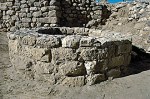
I keep trying to understand the movements of these ancient peoples. I guess I’d have to go back to school in Old Testament studies to really comprehend the places and names and how they correlate to today’s maps.  And yet, even with my limited knowledge, I enjoy making the small discoveries, like the meaning the place Isaac lived after Abraham’s death and its relationship to Hagar [Genesis 16:7].

Genesis 25:8-9a; 10b-11
Then Abraham breathed his last and died at a good old age, an old man and full of years; and he was gathered to his people. His sons Isaac and Ishmael buried him in the cave of Machpelah near Mamre . . . There Abraham was buried with his wife Sarah. After Abraham’s death, God blessed his son Isaac, who then lived near Beer Lahai Roi [Well of the Living One Seeing Me].

I’m assuming the name of this well was carried down by word of mouth because of Hagar. She saw God through the Angel who told her to return to Sarai, her mistress, and to believe in the future of her son, Ishmael.

Now, after all that Isaac had been through, both he and his half-brother, Ishmael, bury their father near the great trees of Mamre, and Isaac moves his household to this undoubtedly plush area near the river and the primary trade route between Egypt and the north. Isaac, too, wanted to be seen by God. I want to be seen by God too. Don’t we all?

Don’t we all want the intimacy of being seen, being known, being embraced by a loving God? This is, after all, the promise of Christ all along: despite it all, God sees you and accepts you . . . accepts me. Just so.

Come to the well and drink. Be seen. And, of course, once that “door” is open, I can see too. (Like the old refrain when having one’s picture taken in a crowd: if you can see the camera, the camera can see you.)

God is not looking through dense shrubs or hiding behind the clouds. God is within through the Holy Spirit. That is Well of the Living One Seeing Me. Right here.

Read Full Post »

Icon: John the Baptist

To wash ceremonially in ancient Jewish times was to participate in a mikveh (or mikvah). For rituals, particularly washing from impurity, required “living” or flowing water such as a river or mikvot (the mikveh place) fed by a natural spring. It constituted the washing away of the old impurities and to mark the beginning of the new.

Matthew 3:1-2,
In those days John the Baptist came, preaching in the wilderness of Judea and saying, “Repent, for the kingdom of heaven has come near.” . . .  “I baptize you with [or in] water for repentance. But after me comes one who is more powerful than I, whose sandals I am not worthy to carry. He will baptize you with [or in] the Holy Spirit and fire.

John the Baptist treated sin as the greatest impurity of all and called everyone who wanted a new start to celebrate a mikveh with him, right there in the desert, in the river Jordan. While priests, via the regulations in the Torah and other rabbinical writings, performed the mikveh for a variety of circumstances (after sexual relations for men, a menstrual cycle for women, after the birth of a child, upon declaring someone healed of a skin disease or leprosy, prior to Yom Kippur, and so forth), this may have been the first time that a mikveh was performed without a traditional priest.

John’s message was clear: prepare the way (prepare yourselves) for the coming Messiah. Release the old and make room for the new.

The water submersion was a ritual meant to mark a moment in time. And yet, John promised another moment, a time that would be marked by something more permanent than water: the Holy Spirit and Fire.

The baptism of the Holy Spirit came after Jesus’s resurrection, the gift was given (and promised) to all believers — the in-dwelling of God [Acts 2]. This in-dwelling changed everything and everyone. We tend to minimize this deeply motivating presence today.

There is so much “Jesus Junk” (Tchotchkes) and pat phrases like “Jesus loves you brother.” But it’s more than that. It’s not just that Jesus loves you; it’s that Jesus is you [Philippians 1:21]. Jesus and the Holy Spirit are one. And once Jesus has been invited to occupy us, then the process of true sanctification begins, fusing me and the Christ. And with sanctification, unnecessary elements must, like chaff, be cast away and in some cases, burned away through experience, pain, persistence of motion, and repetition. We are all intended to “get it.”

The occupy movement from Wall Street to Washington, D.C., has nothing on the potential power and change that comes from the occupation of a human being by the Holy Spirit. This is the most authentic change of all.

Read Full Post »

« Newer Posts - Older Posts »