Feeds:
Posts
Comments

Posts Tagged ‘Jesus’

Art by Favianna Rodriguez

Art by Favianna Rodriguez

But while he [the prodigal] was still a long way off, his father saw him and was filled with compassion for him; he ran to his son, threw his arms around him and kissed him. [Luke 15:20]

It’s not that I didn’t know what compassion means. And yet, despite reading or hearing the prodigal story hundreds of times, I never put the father in this state: “a feeling of deep sympathy and sorrow for another who is stricken by misfortune, accompanied by a strong desire to alleviate the suffering.” [dictionary.com]

I had always read longing and forgiveness into the father’s response, that he ran to the son out of love and joy. However, I finally see, compassion means that the father was struck by the extent of his son’s calamities and he did the only thing he could do for the young man: show him love and acceptance. The son had punished himself enough already. 

The results of the son’s disastrous choices were all over him. Where he had left the family home as a gallant young “prince” among men; he had returned as a slave. And although he would never again be landed (since the he wasted away his inheritance), he was still a son. Life would not be the same in that household: from that point forward, I am guessing the son would have to serve both his father and his brother. He would have to work. And if he wanted an independent life, he would have to create it for himself, save money and rebuild. The one thing he would have was safety and hopefully, a willingness to be instructed.

When I was so sure I knew my way, I too floundered. I wasn’t given my inheritance (for there was none really, in my family’s poverty), but I knew how to work hard and support myself. But I spent all of my money unwisely. I indulged my fantasies without examining them. I looked at the “good life” and yearned for it. And since I couldn’t have it in reality, I tried to have it in reflection: dress that way, spend that way, play that way, drink that way. But of course, the “way” continued to be a pretend world.

I was on a downward spiral. And although I never hit rock bottom as so many must before they turn back or step out of the maelstrom, the direction I was heading is so clear to me in in hindsight. Drugs, alcohol, and carnality were my daily bread. I was not a slave to them yet, but soon. From this, like the prodigal, I turned and tried on the arms of God. I am one of the lucky ones.

But I still have that personality. I still make impulsive choices, I can still spend recklessly, and I indulge both my whims and my children. I still have an addictive personality and can become somewhat obsessed with an idea or incident or food or whatever. I even catch myself yearning for the mega millions jackpot, as though money alone would solve my woes.

It took me a long time, really, to become a true believer, a Christ follower, a Christian even. I could never quite believe I’d done it, given up that other dream of fame and fortune and notoriety in the Big Apple. For the longest time, I went through the motions of extreme faith from “not quite authentic” manifestations of the charisma to dancing and laughing and anything else that would keep my mind occupied and keep me busy. I just kept adding and adding to my plate.

But today, I see that my plate is being stripped away. And I am getting back to the truth of me. And I know my God has compassion for me now just as He/She did when I came to the Spirit quite raw. I am not that other kind of prodigal anymore. I am shedding the layers of “shoulds” and working toward the inner sanctuary of my heart to a me I have never revealed before or known. She has been lost for a long time.


 

Read Full Post »

Fig Tree by Dee Schenck Rhodes

Fig Tree by Dee Schenck Rhodes

A parable: “A man had a fig tree growing in his vineyard, and he went to look for fruit on it but did not find any. So he said to the man who took care of the vineyard, ‘For three years now I’ve been coming to look for fruit on this fig tree and haven’t found any. Cut it down! Why should it use up the soil?’“‘Sir,’ the man replied, ‘leave it alone for one more year, and I’ll dig around it and fertilize it. If it bears fruit next year, fine! If not, then cut it down.’” [Luke 13:6b-9]

One more year; one more growing season to change; one more opportunity to work with the gardener and produce fruit.

We’re not so great at parables anymore, or maybe we’re just as dense as the disciples were back in Jesus’s time. So many times the disciples had to ask Jesus to explain the stories. But not this one; this one is up to us to figure out.

Who is the owner of the vineyard? Who is the one who cares for the vineyard? Who is the fig tree? What is the fruit? Why didn’t the tree produce fruit? How would the soil be fertilized? And what does it mean to be cut down?

God is the owner. Jesus is the farmer/caretaker. I am the tree. But what is the fruit?

I did a little investigating and apparently the fig tree was one of the most valuable trees in Israel at that time because it bore fruit three times a year. So, in the parable, that means that this particular tree, still hadn’t produced fruit in any one of the seasons that had passed. So, why keep this tree? It was planted for the purposed of yielding fruit. That was the job of the tree, not acting as a shade tree, not as an art object, and not as a road marker. Fig trees bear figs. Fig trees don’t bear apples or peaches or cherries.

Each human “fig tree” has its own fruit as well. Oh, sure, there are the fruits of the spirit (See Galatians 5:22-23 if you want to review the list). And certainly, all trees should have these attributes. On the other hand, a friend of mine said that the fruit of the tree is more believers, more followers of Christ, more like-minded, like-spirited people. This interpretation makes me feel like it’s a numbers game (how many people have you “saved?”).

No, I’m much more interested in the specific and unique fruit that comes from me. Or you. Or any other believer. We each bring something to the table of community and to the Body of Christ. Sometimes, it’s a complex recipe and my part may be small compared to another, or vice versa. I know there are seasons I have missed. But I am grateful for a merciful gardener who is willing to tend and nurture my soil. I am still growing. I am still in the orchard.

The soil is fertilized through prayer and study and relationship.

I can only say, I am still here. And as along as I am, then I will take comfort that my seasons are more fruitful than I may realize. It is not I who must judge the harvest.

Read Full Post »

life deathJesus answered, “Do you think that these Galileans were worse sinners than all the other Galileans because they suffered this way? I tell you, no! But unless you repent, you too will all perish.” [Luke 13:2-3]

I had to go back and read this verse in context. What was Jesus really saying here? And then I understood. He is reminding the people, again (and again) that the death of the body is one death, but the death of the spirit is far more serious. If the personal spirit is in relationship with the Holy Spirit, if the life force within is right with God, when the body dies, there is more.

Apparently, based on this scripture, death is not a reflection of one’s goodness or evil: death comes when it comes for other reasons. And “like a thief in the night,” [I Thess 5:2] we cannot know the time of death anymore than we can know the  time of Christ’s return. Most of us can’t even fathom an early death. Not really. Who expects a child to die in three days time? Who expects a sister to die in the lobby of a hotel in Europe? Who expects a husband to die in a car accident?

When I was in school, I remember how much I hated pop quizzes. You know why? Because I was a last minute studier. I’d pull all-nighters the day before a big test or when an assignment was due. But a pop quiz? That would show the truth of it. I wasn’t on top of my work. I wasn’t doing a little every day. I was a procrastinator.

But this technique doesn’t work so well in the things of God, in the things of the Spirit, in the things of becoming more Human (that is the real intent for human). That journey is outlined for us all in the scriptures and writings of the ones who have gone before us. What are we waiting for? Granted, if I follow the paradoxes (love your enemy, give and it will be given to you, etc.), and the surrendered lifestyle, I am promised that my life here and now will be better for it. But more importantly, it is the life within that really counts.

How many ways does Jesus (or really, any of the saints and Spirit-led) have to tell us that there is more to “life” than what we see, hear, feel, and touch?

Do you want more? Are you thirsting for more of that promise? I am.

Read Full Post »

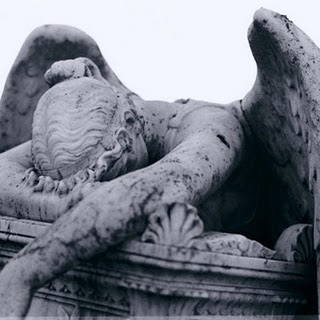
grieving angel“For my thoughts are not your thoughts,
    neither are your ways my ways,”
    declares the Lord.
“As the heavens are higher than the earth,
    so are my ways higher than your ways
    and my thoughts than your thoughts.” [Isaiah 55:8-9]

Here’s the difference. When you and I “think,” it’s just an opinion or point of view or perhaps a bit of problem solving. When God thinks, things come into being or mountains move. The answer to the question, “what is God thinking” is incomprehensible to humans. Maybe, “what are You making?” would be better. I get some solace from my faith in a blueprint. Some.

We’ve gotten too casual with God. Perhaps it’s part of the new informal culture where jeans are always acceptable and language has become various letters of the alphabet. YKWIM? We want the “thumbs up” Jesus. We don’t want to be afraid of God so we make God cozy and grandfatherly.

And although a relationship with God can be warm and intimate and full of mercy, there is a point when God basically says, “because I said so.” And this moment needs to be accepted with the same surrender as “cootchy, cootchy, coo.” A creator has the ability and the right to destroy or alter or remake the object. “But who are you, a human being, to talk back to God? “Shall what is formed say to the one who formed it, ‘Why did you make me like this?’”Does not the potter have the right to make out of the same lump of clay some pottery for special purposes and some for common use?”[Romans 9:20]

Lately, some terribly difficult circumstances have dropped into the lives of my colleagues and friends: several people have been diagnosed with cancer or had serious surgeries, a couple of people have been on dialysis for over a year, and now a 3 1/2 year old child died just three days after being diagnosed with T-Cell leukemia.The child’s death has been the most difficult of all.

It’s hard to avoid the gripe, “what is God thinking?” Is there a satisfactory answer in my world? Not really.

I understand intellectually. Each journey is different. And although I have come to a peace about my friend Mary dying from pancreatic cancer and how I admire her as she embraces this new path in her life odyssey, the bottom drops out of my confidence, when it’s a child. The grief is heavy, the weight of a family’s loss is palpable.

It’s not the first time I’ve witnessed the agony. Some years ago, I went to a viewing of a baby who had died of SIDS. The mother was so distraught that she pulled the lifeless, embalmed child from the coffin and carried her around the room of the funeral chapel. She was inconsolable. And there was nothing to say.

Every step of faith in the face of pain and trauma and sorrow, is an excursion into the mind of Christ, a dance with the Holy Spirit, a siege at the entrance of the “holy of holies.” But the answer is always the same, “God’s thoughts are not my thoughts, God’s ways are not my ways.”

Read Full Post »

Looking for GodSeek the Lord while he may be found;
    call on him while he is near.
Let the wicked forsake their ways
    and the unrighteous their thoughts.
Let them turn to the Lord, and he will have mercy on them,
    and to our God, for he will freely pardon. [Isaiah 55:6-7]

It’s not that God is missing, you know, or that God is moving closer and farther away. It’s the seeker who is either ready or not to discover God in Spirit, working and moving, speaking and transforming our lives. And when we, as seekers, do have a personal experience with God, that is the best moment to ask those tough questions, to not let go, like the woman with the issue of blood [Matthew 9:20-22] or Jacob, as he wrestled the angel [Genesis 22:24-30]. Both of these people knew their time had come, their opportunity, to hold tight, to touch and encounter God.

When someone who does not know God has that initial epiphany, it’s as though God appears out of nowhere, and suddenly, their new found belief, brings God close, brings in the reality of Christ Jesus, and the Presence of the Holy Spirit. It’s an “aha!” moment. In those first flushed days, it is the easiest time to ask forgiveness, to surrender the sins and bad choices, to confess.

But later on, we become more closed and closeted, despite being faithful followers of God. It’s like running into someone you know . . . I mean, you know you know the person, you go to church together or you were at meetings together, and yet, no matter how hard you try, you can’t remember the person’s name. Do you confess that you don’t remember or fake it? That would be me, at least. I am too embarrassed to confess. And so I have been with my God, too embarrassed to review that same error in judgment, that same mistake, that same blasphemy. It’s not like God doesn’t know. But I am the one who cannot bear it. So, I open up the secret room and toss yet another “truth about me” inside and shut the door.

Jesus even taught that we are to forgive one another, not just seven times, but seventy times seven times [Matthew 18:22], symbolically meaning that forgiveness has no limits. Would God do less?

I say I am a seeker of the Christ and the fullness of the Spirit within, and yet, I withhold my truths and sins. When I do this, I am not seeking at all, but hiding, like Adam and Eve in the garden [Genesis 3:8]. God sought them. God is doing the same with me.

It’s so simple: when I seek, I find.

Read Full Post »

miraclesA man in the crowd called out, “Teacher, I beg you to look at my son, for he is my only child ” . . . Even while the boy was coming [toward Jesus], the demon threw him to the ground in a convulsion. But Jesus rebuked the impure spirit, healed the boy and gave him back to his father. And they were all amazed at the greatness of God. [Luke 9:38; 42-43]

Oh, I know. It’s uncomfortable to talk about demons, the devil, miracles, and all that stuff outside our normal understanding of how stuff works. Some people can’t even stand the word “evil” as though excluding it from one’s vocabulary will make it non-existent.

And yet, I contend, if we have accepted any part of the Christ story, we must be willing to consider the reality of the other parts. In other words, there are ways that our lives can and are impacted outside of a three-dimensional world. There is a spirit world and within it, forces move in a way that we may not understand, but that does not mean they don’t exist.

In recent weeks, I was instructed by a doctor to read a book about the importance of the mind in regards to pain in my body. It’s not that the pain isn’t real, it’s that the pain is camouflage of other things going on and the mind, can indeed, intercept it. But I must be aware of this possibility before anything can happen differently. And I’m thinking miracles fall within this category, we have to have knowledge and acceptance of the possibility. This is the groundwork for healing. This is the groundwork for transformation.

It’s not important to know the “how,” but simply to surrender to the power of God to do.

What is even more interesting is that Christ empowers believers to do the same for others. Whoa! Prior to Jesus meeting up with the father and the demon-possessed boy, a few of the disciples had been given a crack at it. Nada. There was still a disconnect. This story is actually told in three of the gospels (Mark 9:37-45 and Matthew 17:14-23) and Jesus explains that both faith and prayer are the cornerstones of miracles. Not faith in ourselves, but faith in the God who has the power to do (or not do).

Of course, there is another truth I’m seeing in this passage. I know that miracles are wonderful, particularly for the suffering human. But I don’t believe that miracles happen for the sake of the person. They have to be within God’s purposes, God’s scope, God’s plan. That may sound harsh, but let’s be honest, if it were otherwise, ALL would be healed. We are not all healed. Sometimes the human journey is full of heartache, illness, poverty, and sorrow. I don’t understand that any more than the next person.

So, what is my role? Do I ask for the miracle or not? Do I ask for the demon to be cast out or not? Do I ask for the healing or not?

One mistake in this asking process is to add the little insurance statement at the end, “if it be your will.” Well, that covers all the bases then, doesn’t it? I have a little back door when the healing doesn’t happen: must not have been God’s will. Yada, yada, yada. It doesn’t, however, do much for the faith angle though, does it?

So here’s the bottom line for me: “Don’t ask if I don’t believe it IS God’s will.” And if I don’t know, then don’t pray, because honestly, that’s perverse. That’s so maybe. It’s a disservice to my God who can heal and cast out demons in a moment. Silence is better. Prayer is better in private then, asking God for clarity and faith, courage and heart, vision and transparency. These then, would set the stage for God to work through me (or you).

Read Full Post »

 mouth in motionMeanwhile, Peter and those with him were slumped over in sleep. When they came to, rubbing their eyes, they saw Jesus in his glory and the two men standing with him. When Moses and Elijah had left, Peter said to Jesus, “Master, this is a great moment! Let’s build three memorials: one for you, one for Moses, and one for Elijah.” He blurted this out without thinking. [Luke 9:32-33, The Message]

Oh that Peter, a man after my own heart . . . er, verbal mistakes. It’s all about the enthusiasm, I know. Believe me, I know. If I get excited about an idea, I can’t wait to blurt it out. And of course, I speak with such authority! No wonder people are put off. But how do I explain it? I get a picture in my head and without analyzing what that picture might mean or the ramifications of actually implementing this picture, I share it.

Of course, I know right away when I’ve blown it. Either the people around me have a glazed look in their eyes or they look down at the table at a meeting. Bad idea, I get it. Bad idea.

If only this would be enough and I would stop. But once my mouth is in motion, I keep at it, trying to figure it out as I go, trying to massage the idea as it comes barreling forth, trying to fix what I said or add enough details that might salvage the moment. Instead, I manage to dig a deeper hole. Been there done that . . . a million times.

But Jesus was not engaged with his human friends at that point, he was transfigured (perhaps that body was more like the one people saw after his resurrection, who knows). And in that state of transfiguration, Jesus was not of this world, but transcending dimensions (something no less miraculous than feeding 5,000 and raising the dead). The source was the same: God. And really, who knows who those other two “figures” were or if their presence was relevant to what Peter and John saw. We’ll never know for sure.

And why did Jesus bring Peter and John along at all? It’s not like Jesus hadn’t gone off alone many, many times before that. He wanted them to witness the transfiguration. Why?

This weekend, I’ll be teaching at the Sunday evening Launch service on silence. Just another paradox in God’s economy. 🙂

Read Full Post »

« Newer Posts - Older Posts »