Feeds:
Posts
Comments

Posts Tagged ‘Mary’

It’s a baby, a little, little baby. How sweet. How cute. What potential!

This will be a sign to you: You will find a baby wrapped in cloths and lying in a manger. [Luke 2:12, NIV]
babyIn Greek, the word is brephos, which can either mean an unborn child or a newborn child, but interestingly enough, this word is gender neutral. As a result, this is the same word that is used for the baby that Elizabeth carries in her womb and “leaps for joy” when Mary came to visit [Luke 1:41], along with six other references. And my favorite reference is in I Peter 2:2, where brethos is used to describe young believers who should crave “spiritual milk,” and cast off the food of the world.

But I’m getting off track. I wanted instead to talk about a baby’s potential. You see, from the outside in, we do not know what is in store for every baby we see. Facebook is filled with pictures of babies, taken by proud parents, who are full of hope and expectations for their baby. They want to give this baby the best of everything, the opportunities, the nourishment, the foundation. They love this baby so much.

And yet, how many mothers collapse in grief when their child becomes a murderer or a drug addict or an abuser? How did this happen? What happened to all that potential?

We know that prophecies abounded about the Christ child who would come into the world innocently enough, but who knew his life would only last 33 years? Who knew he would be mostly rejected? Who knew, really, that it would all happen to this particular baby? Not even the mother knew for sure, despite the miraculous circumstances of his birth. She continued to ponder all those things in her heart [Luke 2:19]

A baby depends on the “village” around him/her to grow and become. If we succeed, if God’s intent is encouraged and prevails, we have a saint. But if we fail that child, what then?

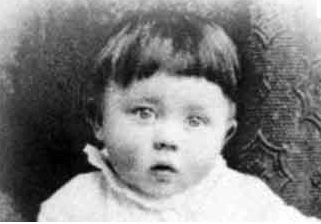
Hitler’s First Photograph
——-Wislawa Szymborska

And who’s this little fellow in his itty-bitty robe?
That’s tiny baby Adolf, the Hitlers little boy!
Will he grow up to be an LL.D.?
Or a tenor in Vienna’s Opera House?
Whose teensy hand is this, whose little ear and eye and nose?
Whose tummy full of milk, we just don’t know:
printer’s, doctor’s, merchant’s, priest’s?
Where will those tootsy-wootsies finally wander?
To garden, to school, to an office, to a bride,
maybe to the Burgermeister’s daughter?

Precious little angel, mommy’s sunshine, honeybun,
while he was being born a year ago,
there was no dearth of signs on the earth and in the sky:
spring sun, geraniums in windows,
the organ-grinder’s music in the yard,
a lucky fortune wrapped in rosy paper,
then just before the labor his mother’s fateful dream:
a dove seen in dream means joyful news,
if it is caught, a long-awaited guest will come.
Knock knock, who’s there, it’s Adolf’s heartchen knocking.

A little pacifier, diaper, rattle, bib,
our bouncing boy, thank God and knock on wood, is well,
looks just like his folks, like a kitten in a basket,
like the tots in every other family album.
Shush, let’s not start crying, sugar,
the camera will click from under that black hood.

The Klinger Atelier, Grabenstrasse, Braunau,
and Braunau is small but worthy town,
honest businesses, obliging neighbors,
smell of yeast dough, of gray soap.
No one hears howling dogs, or fate’s footsteps.
A history teacher loosens his collar
and yawns over homework.

— Stanislaw Baranczak and Clare Cavenagh, translators
from The People on the Bridge


Read Full Post »

There’s a word that conjures an immediate response I’m sure. From billboards, “Virgin : Teach Your Kid it’s Not a Dirty Word,” to Virgin America Airlines to put-down, “You’re still a virgin?” What does this hot word mean in your world? Or mine?

Our Lady of Guadalupe by Pristine Cartera-Turkus

Then Isaiah said, “Hear now, you house of David! Is it not enough to try the patience of humans? Will you try the patience of my God also? Therefore the Lord himself will give youa sign: The virgin will conceive and give birth to a son, andwill call him Immanuel. [Isaiah 7:13-14, NIV]

Of course,  theologians have since uncovered a less than miraculous explanation of Isaiah’s prophecy since Jewish culture assumed that all young women were virgins. They had a good reason for this assertion since sex outside of wedlock was punishable by death. The Hebrew word for virgin as it is used in Isaiah is Alma, or young woman. When the these verses were translated into the Greek, the word Parthenos was selected which had only one meaning, virgin. (By the way, small piece of trivia, the Parthenon’s name came from this same word and one of the reasons was that this temple was filled with temple prostitutes that were virgins – and apparently disposable after a single use.)

The point in the nativity story, I suppose, is not that Mary was a virgin, since that was the norm, the point was that she was impregnated supernaturally. In fact, scripture articulates that Joseph, her fiancee did not have sex with her until after the birth of Jesus [Matthew 1:25]. And for many people, this miracle stops them in their tracks. And some denominations take Mary’s virginity to the next level, saying she was made sinless as well, creating an immaculate conception. [For more on this topic, see Let Us Reason Ministries online.]

We’re living in a time of science and reason and miracles of any kind are always suspect. In my mind, the entire concept of God providing a propitiation or atonement for the choices that created a state of human separation from God is a gigantic miracle in and of itself. The methodology would have to be out of our ken in order to make it work.

Ancient humans seemed to naturally understand the idea of atonement, sacrificing all kinds of animals and daughters to appease the gods, the sun, the weather, or whatever else they could not understand. They seemed quite clear about the basic idea of sowing and reaping. Even Karma, an Eastern idea of cycles, supports the supposition that there are repercussions to our choices (both good and bad).

The virgin birth is actually somewhat inconsequential to me. The idea that God became fully human is much more intriguing. The idea that fully human God (as Jesus), came as an atonement is even more absorbing.

I just want to think about that today.

Read Full Post »

Mary and Jesus FeetThen Mary took about a pintof pure nard, an expensive perfume; she poured it on Jesus’ feet and wiped his feet with her hair. And the house was filled with the fragrance of the perfume. But one of his disciples, Judas Iscariot, who was later to betray him, objected, “Why wasn’t this perfume sold and the money given to the poor? It was worth a year’s wages.” [John 12:3-5]

I just got the real picture of Mary and the nard (spikenard oil) and Jesus’s feet. In the past, while reading this passage and other similar ones about a woman who washed or anointed Jesus and then used her hair afterwards, I imagined her holding her long strands of hair to wipe like a cloth. But now I see differently. It’s more like nuzzling. I wish I could explain more clearly what I see in my head, this women kissing, embracing, stroking and pressing her head to Jesus’s feet (or head or hands or mantel); holding him close to her face, her lips, her hair. I think about my own ways of  holding close my kids or my pets. I put them right up to my face and hair, cheek to cheek, head to head. It’s intimate, it’s loving, it’s tender.

Essentially, I don’t believe this act was about washing or cleansing. Instead, it was purely a demonstrative act of love. And I suppose it could be called a humble act but love, but then, in its purest form, isn’t love humble anyway. At least it should be.

Judas’s response is more dramatic in hindsight. After all, we know now, he was the betrayer. But, in that moment, his reaction told a different story: he revealed his inability to recognize love. Following Jesus was never about love, it was about freedom. He must have been a “reasoning” man: perhaps even calculating. His passion was the overthrow of the Romans, the victory of the long-awaited Messiah who would bring Israel back to its former glory. For him, Mary’s act was, at best, sentimental and certainly a waste of resources. He was pragmatic and eventually (sooner than later), this led him to choose unwisely, to “move things along,” to force Jesus’s hand (without knowing what that would really look like). Judas did not expect his rabbi to be crucified. Instead, he expected an uprising of great proportions, a revolution. But he never understood the real revolution was in the heart.

Mary’s heart was already set free. She loved Jesus with abandon.

Read Full Post »

LazarusSix days before the Passover, Jesus came to Bethany, where Lazarus lived, whom Jesus had raised from the dead. Here a dinner was given in Jesus’ honor. Martha served, while Lazarus was among those reclining at the table with him. [John 12:1-2]

Jesus was on his way to Jerusalem, not only to celebrate the Passover, but undoubtedly he knew, he was going to his suffering and death. On the way, he stopped to be with friends. These were not necessarily disciples as we have no record that Lazarus and and his sisters followed Jesus in his travels. They were, instead, a home base, a place of rest.

I find it amusing that John would mention that Martha served, this very same Martha who Jesus chastised for becoming overly upset about serving while her sister sat at his feet listening (that would have been weeks earlier). I believe it is mentioned intentionally because this was still Martha’s way. Jesus never intended for Martha to stop being Martha, but to simply stop comparing herself to others and stop stressing. She was good at what she did but Jesus wanted her to check her priorities. I can relate to that, the Martha that I am. And so, on this final trip, his  final visit to their home, Martha served her Rabbi and Lord.

But the continuing story of Lazarus has always fascinated me the most (undoubtedly because of my love for fantasy and science fiction). In Romans 6:9, Paul writes about Jesus, “For we know that since Christ was raised from the dead, he cannot die again; death no longer has mastery over him.” And I cannot help but wonder, what happened to the ones Jesus raised from the dead (Lazarus was not the only one, there were a few others)? What was life like afterwards? Did they have awareness of death and then life again? Was there a sense of destiny, a role that needed to be fulfilled by coming back? Did Jesus charge them with a job to do? Did Lazarus die again? Did the widow’s son or Jairus’s daughter, Tabitha, die again?

I’m just asking.

And why did Jesus weep at the death of Lazarus? He delayed coming to the sick bed of Lazarus on purpose. He knew Lazarus was dying. And yet, when Jesus finally arrived in the midst of the raw grief and shock of Mary and Martha, Jesus weeps (John 11:35). So much is assumed is about his weeping, but I am not so sure it is merely for his love for Lazarus. Instead, I believe (and this is pure conjecture on my part) that Jesus wept because of the symbolism that Lazarus’s raising implied. Jesus was seeing himself, for he too would walk from a grave and the stone rolled away.

But Lazarus did not come out with a different body, at least, there is no indication that he could transport himself or walk through walls. In fact, this is the last time we hear of Lazarus at all, reclining at table with his friend, his Rabbi, his Lord.

Is Lazarus still here? I don’t know. But what a story that would be, what an adventure. It’s on my list of tales to write.


Read Full Post »

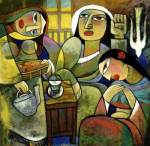
Painting by He Qi Chin

The hard part in these verses, the first of seven admonitions to the churches in Asia under John’s authority, is the complimentary tone, the praise for all of their hard work, and in particular, their endurance and perseverance. And yet, it is for nothing without love.

Revelation 2:3-4
I know you are enduring patiently and are bearing up for My name’s sake, and you have not fainted or become exhausted or grown weary. But I have this [one charge to make] against you: that you have left (abandoned) the love that you had at first [you have deserted Me, your first love].
[Amplified]

This is the classic Mary/Martha conundrum [Luke 10:38-42] where Martha, the overly busy one is chastised by Jesus whereas Mary is praised, not for her “good works” but her devotion, her love.

I think about my early weeks as a believer. They were indeed like the proverbial honeymoon. I wanted to be in the Presence as much as possible. I prayed effortlessly for hours. I devoured the scriptures, cover to cover, several times over. I wanted to know God. I wanted to catch up. I had missed so much.

As a child, I was raised in the Latvian Lutheran church, and that, in itself, is not bad, but growing up in America where my heritage became more and more of an add-on instead of a way of life, I kicked against the church just as I kicked against Latvian school and speaking Latvian in the home. I did not really listen. I did not learn. And as a result, by the time I reached adulthood, I knew the Bible as a group of stories and parables. It held no life.

Many years later, in the noise and speed of New York City, miles from my hometown in Indiana, living the life I had imagined a young actress should lead, the last person I expected to encounter was the Christ.

My encounter was personal, just the Word, the Presence and me, Christmas Eve, 1979. At first, uncomfortable with my new found love, I mumbled my decision to follow this Savior. I didn’t really want anyone to know. But things do change and people saw my change and the old haunts, the old ways, no longer had appeal. In some cases, it was a test . . . not for me, but for this God I had chosen to follow. And that one was faithful, eventually removing me from each and every terror, drug habit, drinking habit, and erotica.

My first love first loved me.

But thirty years is a long time and like an old married couple, I have become somewhat cavalier in my relationship. Still busy, still faithful, but without the wonder. I am a good volunteer. I say “yes” to almost every task. I fill my calendar.

Irmgarde,” the Lord might say, “you are worried and upset about many things, but only one thing is needed. And Mary is an example of what it means to choose what is better.

Read Full Post »

A fantasy story line comes to mind: certain characters are entrusted with a secret stone or message or magic phrase and they are called to face numerous odds to protect it, embrace it, and nurture it. With each successful engagement, the power enlarges but so does the evil that opposes it. Each time, engagement becomes more difficult. The opposition is weighty.

Jude 1:3b
. . . I felt compelled to write and urge you to contend for the faith that was once for all entrusted to God’s holy people.

It’s fanciful I know, but I think, as believers, we sometimes lose the wonder of what we have in the Christ: that Holy Spirit, that Truth, that potential for joy and peace within. The experience of eternity is within. It is the spirit, after all, that lives on after the body fades. Part of the message we hold determines the quality of our eternity. We also lose track of the power of the opposition, as well as its inventiveness and ability to dissemble.

Does anyone else wonder why the message was sent in that particular era dominated by the Roman empire? What was it about the plight of the Jewish nation (one of many) that compelled God to send the whole Story. The people cried Hosanna! (save us) and God sent the most unlikely Savior, not a general leading a great army to destroy the Romans but a baby born to a couple of poor folks.

No instant messaging was available, no news feed, no reporters on the scene. In fact, what witnesses there were, few had much credibility: shepherds (one of the most disreputable “professions” of the day) were supposedly informed by a sky full of angels? Right. And what were they smoking? Or, what about those foreign guys: mystics and astronomers that weren’t even of the faith? They probably had an ulterior motive. I mean, the people closest to the event (like the innkeeper, let’s say), don’t seem to have much place in the story or what about all those other people who were stuck in Bethlehem for the census? No, I think it was a pretty hushed affair, just another baby and just another mouth to feed.

But Mary treasured up all these things and pondered them in her heart. [Luke 2:19]

Mary was the first one who was entrusted with a truth, a power, a hint of what was to come. She did not stand on a street corner and declare the message. She didn’t start a blog or expect special treatment. She didn’t go to the governor and display her treasure. She waited. Her role was not truly expanded until after the death and resurrection of Christ.

I am entrusted with faith. I accepted the quest, the mission. But I am not so sure I have been wholly conscious of my role. Or perhaps, that full expression of my understanding as been successfully undermined by the adversaries.

I think my next foray should be covered with a backup. “For where two or three gather in my name, there am I with them.” [Matthew 18:20] I need to find those partners, like the trio from Harry Potter or the Three Musketeers or even, the three disciples who knew Jesus the best.

It’s a journey all right and it’s a journey that is best taken together.

Read Full Post »

On Easter morning, we need to consider this detail: women played a key role as messengers of truth. In fact, from the visits to Bethany through Jesus’s Paschal journey and on into the days and weeks after the resurrection, women were players: devoted, faithful and strong. They still are.

Romans 16:1-2, 6, 12-13, 15 and more
I commend to you our sister Phoebe, a servant of the church . . . Greet Priscilla and Aquila, my fellow workers in Christ Jesus . . . Greet Mary, who worked very hard for you. . . . Greet Tryphena and Tryphosa, those women who work hard in the Lord. . . . Greet my dear friend Persis, another woman . . . Greet Rufus, chosen in the Lord, and his mother, who has been a mother to me, too.

At first blush, Romans 16 appears as boring as Matthew’s genealogy used to be for me. But a closer examination reveals the same mystery: the powerful women! There are lots and lots of women mentioned here and in most cases, they are clearly cherished by Paul.

The genealogy in Matthew 1:1-16 was such a sleeper for me until I experienced an epiphany and saw the reason behind mentioning the women in those verses (Tamar, Rahab, Ruth, Bathsheba, and Mary). They had a message for me: if God could use them, he could use me. And out of that revelation, I created a one-woman show that I toured for several years called Pente.

Now, in this chapter, I see another group of women with very little story to illuminate their place in the timeline, and yet, they are there: Phoebe, Priscilla, another Mary, Tryphena, Tryphosa, Persis, Rufus’s mother, and countless unnamed ones since households were listed by the head of house alone. But women were there, serving, loving, praying, and working in tandem with their families to illustrate the message of Jesus.

Scholars assume Phoebe actually carried the letter of Paul to the Romans. Was she allowed to read it? Did she travel from church to church (there were many house churches) in that great city? Did she carry additional personal messages from Paul? She was from a coastal city of Corinth, at least 600 miles from Rome. That was no gentle expedition. I’m not saying she was the Pony Express, but it’s amazing for that time period for a woman to travel with this type of a mission.

I know, there are other places where Paul seems to give women the back seat. I struggle with these sections too. But as I study those areas along my New Testament trek, I want to remember this Paul, who sent Phoebe with a critical letter to the gentile believers in Rome.

All of the women to whom Paul is sending greetings are commended for their “work.” I doubt he means “woman’s work” either. He is talking about the same work that all of us are called to do: being a witness in word and action: fulfilling the call of Christ in our lives, equally distributed by grace.

Oh yes, this is a day to remember and celebrate that Jesus’s work on the cross included a great emancipation for women of faith. Amen.

Read Full Post »

« Newer Posts - Older Posts »