Feeds:
Posts
Comments

Posts Tagged ‘choice’

stone altarThe erecting of pillars and altars and memorials was prevalent throughout the journeys of the ancients. Their milestones marked an event in their journeys that was valued, a testimony to the moment. And today, although we have statues and tributes of buildings, walls, and waterfalls to the wars and losses to be revered, there are no remembrances anymore for a life-changing experience with God.

Genesis 35:14-15
Jacob set up a stone pillar at the place where God had talked with him, and he poured out a drink offering on it; he also poured oil on it. Jacob called the place where God had talked with him Bethel [House of God].

In fact, if anything, most of us forget that moment when we cried out to God, “See me, hear me, oh Lord, help me!” And the cry was heard and our circumstances changed.

I am probably being harsh here. I suppose, if I had to recount some key moments when I was touched by God, I could recount them. But I built no memorial, nothing permanent.

Except the words.

I understood today, that these are where I have built my milestones. These are a memorial to my growth as a believer, a follower of Christ. These are the memories collected in digital ink, to help me remember.

It may be time to take this all a little more seriously. For this season, for this time in my life, this milestone, feels important. Perhaps it’s all the talk of apocalypse (even though we joked through the end of the Mayan calendar), there is a sense within me that challenges will come. This is a time of gathering: my thoughts, my devotion, my surrender, my commitment, my disciplines.

Today, God spoke: Remember who I am and where I dwell. Remember who fights the battles. Remember your promise.

Read Full Post »

Some people call it writer’s block, but for me,  it’s more like malaise. I looked it up: “a vague or unfocused feeling of mental uneasiness, lethargy, or discomfort.” I’ve had it for the last month (or more) and I have put less than 500 words (or prayers) to page. This is not good. I need to get back on some solid ground.

Psalm 40:2
He lifted me out of the slimy pit, out of the mud and mire; he set my feet on a rock and gave me a firm place to stand.

Here’s a bit of confession: I haven’t felt like writing. It’s a grievous mistake, I know, because writing (like prayer) cannot be done out of feelings alone. It’s a discipline. A persistence. A slogging-on despite the circumstances. My favorite metaphor for endurance and doggedness leaps up: the tortoise of Tortoise & Hare fame. But you see, I have given way to the Hare again, round and round and round I go, no closer to the finish line, and off the path.

Another confession: if I am not writing, you can assume I’m not praying. The two have gone hand in hand for the last several  years and apparently, the Muse has departed, the Spirit hides behind a cloud, and the galloping horse of time has whipped through my apparently delicate balance of personal retreat with both God and Muse and daily life.

It’s not that daily life is a bad thing. I’ve had an amazing number of experiences and involvements over the past six weeks, from travel to Europe to visit extended family to my Navy son visiting for two weeks and second trip out west. Each agenda was full of laughter and joy and healing. I was much blessed. But. . . I took no time alone. Each day I hit the ground running and every minute was loaded. And really, that’s not so bad in itself. I know. But, once I returned to the days and minutes of normalcy and anticipated routine, I had no anchored place or time. I no longer retreated to my favorite chair (or if I did, I woke up an hour later) and I no longer had a plan for study since I just completed my New Testament journey of echoes, prayers, and meditations. Everything has come to a point all at once and, since my way is unclear, I am still standing at a crossroads of sorts. Where do I go from here?

And the worst of it all? When I stop doing something, I tend to forget how to do it. This is most clearly illustrated in a foreign language. Use it or lose it.

To get good at writing, one must write; and to get good at prayer, one must pray. No other way.

I am amazed how easily and quickly I lost my routine of prayer and writing. In the past, I had conquered malaise by keeping track of my time. I know that sounds anal, but it worked! Each time the inner voice of condemnation would attack me because I missed a day or two of prayerful meditation and study, I had facts to shore me up. Sure, I missed a day, but in a year, I’ve gotten it right over 70 or 80 or even 90% of those 365 days. So, “evil voice,” back off! I’m ok.

That pattern  has worked for the last five years.

And in the writing department, I became a great fan of Anne Lamott and her book, Bird by Bird, who encouraged me to start writing, 300 words a day, every day! And I did. I even completed a manuscript that way. But then, the next step was editing and cutting and slashing and changing and re-writing and soon, 300 words could no longer be used as a measure. I faltered. I am once again unsure, beleaguered by another voice or worse, silence. I tried to give myself a little credit, after all, I was still blogging. At least, I was. I did.

Breathe. I gotta breathe here.

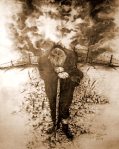
Scratchboard by Michael Halbert

Today, a holiday, I woke with the determination that I would count it a victory day over lassitude and melancholy. I would pray. I would write. I would tend to my inner self. So, how did that go: I slept more than anything else with books on my lap and pen falling to the floor, tea growing cold. I lost four hours of my day to malaise, true malaise. Shortly, I must go to the grocery store for dinner. The day is flying by.

And yet, I do have this to show myself. I am sitting here right now. I made it this far. I crept over the edge. And tomorrow, hopefully, I will make the next step.

It’s time to choose. A way.

Read Full Post »

I’m not paying enough attention. I know there are upright people around me; there are folks who are choosing each day to turn away from the selfish choice and seek peace. Have I become so jaded that I only see the mistakes, the falling short of a person?

Psalm 37:37
Consider the blameless, observe the upright;
a future awaits those who seek peace.

I place the bar very high for myself and as a result, I tend to give too much credence to the dark voice within who points out my failings, my trips, my secret heart. As a result, I appear to do the same to others. Sorry ya’ll.

It’s time to look with different and gentler eyes. It’s time to mark and consider the good moment, the brave choice, the intentional moments of others. It’s time to look for them and to celebrate them.

At work, I can praise my staff for a job well done, but I don’t offer much encouragement to regular people around me, from my kids who struggle each day to navigate their world to my husband who has become too familiar, a presence who has lost his uniqueness, but has become a habit instead. Like being on auto-pilot, I am not looking for the evidence of good choices, conscious choices, dauntlessness.

Who do I admire? Not for their successes in the world, but for their courage to walk the narrow way of faith, to hold fast to the paradoxes of Christ, to live humbly, to seek peace by turning away from self camouflage, to practice transparency and authenticity. I want to celebrate them.

Keep me mindful today that I might see.

Read Full Post »

Art by Joseph Liner

Thirty two years ago, I responded to a nation-wide call to Christians around the country to fast and pray in Washington, D.C. II Chronicles 7:14 was the keystone verse to that call and that day became known as Washington for Jesus. I arrived with national hope for healing but left with disappointment.


II Chronicles 7:14
“. . . if my people, who are called by my name, will humble themselves and pray and seek my face and turn from their wicked ways, then I will hear from heaven, and I will forgive their sin and will heal their land.”

I had taken the call seriously. I traveled a long way, prepared myself to fast, and meditated on the scriptures. In my imagination, the Mall would be filled with prayer like in the days of David and Solomon and the Shekinah glory would fall. Instead, there was amplified praise music and prayer from the stage area, political rhetoric, picnics, vendors selling “Jesus Junk,” street proselytizing, and tracts, tracts, tracts. Hope was being directed to a political agenda and not to the instruction and promises God had given to Solomon.

Granted, it is much more difficult to turn a country’s focus. Change begins at the grass roots level, it begins with the individual.

So, here are the steps to healing that I have gleaned from this scripture. This is where I must begin:

  1. Know who you are. God is speaking to the “people called by my name.” Am I a child of God? I am. I have accepted God’s authority over my life.
  2. Humble yourself. As long as I believe my way is the best way, I can interfere with the divine plan. Humility with others is tough; with God, moreso.
  3. Pray. There are thousands of ways to pray, from casual chat to ritualized liturgy. They are all useful as long as the heart is bent toward God.
  4. Seek God’s face. A little different from prayer, but certainly an aspect of prayer, this seeking implies expectation. If I am told to seek then I am expected to find. The key is understanding that God’s face is reflected in a myriad of ways including the faces of human beings.
  5. Turn aside from the old ways and habits. This is probably the most difficult step if it’s done out of order. It’s not just a quarter turn, it’s a 180. It’s a decision. I don’t even have to walk in that new direction, just turn, and God will show up.

These are steps that will bring healing to any situation. And physical healing? I don’t know, perhaps that too. Perhaps, as the heart and soul are healed, the body follows. But I can’t speak with any authority about that, I have not yet grappled with serious illness.

The promises are threefold if we follow the five steps: God will hear, God will forgive, and God will heal.

I am reminded of the four friends who broke through a ceiling to lower their paralyzed friend down to Jesus [Mark 2:3-5] and it’s revealing to me that Jesus forgave his sins first.

I don’t know how to bring a nation around, but I believe we could start with our own lives. The “land” is basic, it’s the foundation of our Earth. What is foundational in our daily lives?

Read Full Post »

This one is right up there with “be holy!” Peter does not mince words. At least in a couple of other translations, rid yourself of such and such is written as “lay aside” or “be done with,” but in any case, this one is on me.


I Peter 2:1-2a
Therefore, rid yourselves of all malice and all deceit, hypocrisy, envy, and slander of every kind. Like newborn babies, crave pure spiritual milk . . .

Like any plan to change, it’s important to understand the malady. Drunks can’t stop drinking until they know it’s a problem and so forth. I have to look with honesty, are these corrupting attributes part of my life?

Malice is pretty harsh stuff: a spiteful, intentional desire to do someone harm. The gentrified version of this would be deliberate “payback.” Another version of malice might be keeping a simple list of wrongdoings and justifying some other action because of that list. He owes me, as it were. So, I don’t hate anyone and I’m not by nature one who seeks to do harm, but I have kept a few lists hidden in my heart.

Holy Spirit, I give you permission to clean out those lists: reboot my system.

Deceit is a little less malicious but more roundabout in its application. It’s a lie, even a white lie, told on purpose to misrepresent a situation. It can be an exaggeration or a minimization. In any case, it’s a type of hiding. I justify this behavior by saying the truth will just cause more trouble. My kids have pretty much given me the same lame excuse. This needs to stop.

Holy Spirit, I give you permission to open the vault of my subterfuges. Just, please, don’t let ’em out all at once.

Hypocrisy is a form of acting. I really don’t want to admit publicly that I’m a hypocrite, who does? But I am a good actress and that ability crosses over into daily life, I know it does, without even thinking about it. I want people to like me. But I have made this mistake in relationships too often, trying to be someone I am not because I don’t want to rock the boat.

Holy Spirit, keep me authentic through transparency of heart.

Envy is rooted in American culture and we need some intense weeding here. It came to us under the guise of the American Dream but instead has fueled advertising into making us all want what we do not have. Discontentment with what is has become the norm as though it’s the foundation to ambition. I’ve gotten sucked in more than once: it’s the basic reason for my debt.

Holy Spirit, teach me to be content without sacrificing excellence.

Slander is my worst enemy and my best friend. It’s just a stronger word for gossip. It’s those times I put down someone else to make myself feel better. It’s those times I complain about someone else to gather a personal posse to be on my side. It’s those things I’ve said about other people that would be devastating if they were standing behind me. Oh yeah.

Holy Spirit, hold my tongue, keep me mindful of my words.

Peter says the solution to all of this is craving [thirsting, desiring eagerly] the pure “milk of the Holy Spirit.” This picture is the child at a women’s breast, where only the one can satisfy, with no intermediaries.

Do I crave the presence and intervention of the Holy Spirit? Do I crave the Christ, appropriating daily what was given to me by the sacrifice of the God-Man? Do I eat fruit instead of ice cream?

I am still free to choose.

Read Full Post »

Photo by Mike Dykstra

How often do we need to remind someone? In my house, we must remind teenagers every day (and more than once a day) to clean the cat box, empty the trash, and put the dishes in the dishwasher. And how many more times if we added, “choose what is good today.”

Titus 3:1-2
Remind the people to be subject to rulers and authorities, to be obedient, to be ready to do whatever is good, to slander no one, to be peaceable and considerate, and always to be gentle toward everyone.
[NIV 2011]

I haven’t been able to verify this piece of information, but I did read somewhere that parents, in order to teach a small child or toddler to say “please” and “thank you,” must be remind the child at least 10,000 times before he or she will remember. That’s daunting. In a year, that’s 27 times a day. And if one has more than child . . . you do the math.

Apparently, it’s not much better with adults who must learn the basics of walking out the faith, the very faith they have chosen to follow and even profess. They must be reminded to choose “good,” to obey authorities, to be considerate and to be gentle towards everyone.

If we must be reminded, the implication is clear: we’re not doing it. I’m not doing it either. Why?

As Samuel Johnson is quoted as saying: “The road to hell is paved with good intentions.”

Is it really just forgetting to do it? That’s what my kids say, “I forgot.” My husband is particularly irked by his ignored requests, taking that behavior as a choice and therefore lack of respect.

Maybe it’s just our human tendency to take the easier way, the wide road. After all, choosing to “do good” might take me out of my way or inconvenience me. Being obedient might entail putting that person’s request above my own plans. Or, it could be a type of laziness.

But what about the other elements of this teaching from Paul to Titus? What excuse would there be for not keeping the peace or conducting oneself gently? Is it easier to be argumentative and domineering? Perhaps it’s a safety issue again, a control issue. Somewhere along the line, the idea of being gentle feels too much like being a door mat and keeping the peace may mean giving way to my ideas or my decisions.

Or, maybe I just need to be reminded.

Where do the reminders come from? Sermons? Reading? Small group meetings? Blogs? Music? Yes to all of these and more. We immerse ourselves in these mediums to help us remember.

Other faith traditions do the same thing, keeping feasts and festivals and rituals to help the people remember the why’s of faith.

Today is Good Friday, 2011. It is a day for us to remember the Christ who died, crucified, and the mystery that would be revealed. And as we do, we might also remember the rest of the story, the part that leads us to choose a better way each day.

Thanks be to God.

Read Full Post »

Self-control runs as a theme throughout the first two chapters of Titus. Was it the crowd he was teaching or did he have his own impetuous streak? Self-control requires working knowledge and understanding of oneself in order to initiate change. . . . along with a lot of grace.

Titus 2:11-12
For the grace of God that brings salvation has appeared to all men. It teaches us to say “No” to ungodliness and worldly passions, and to live self-controlled, upright and godly lives in this present age, . . .

The problem comes when I confuse self-control with controlling others. I know I can be a control freak and unfortunately, I tend to put too much effort into governing my outer environment and not enough energy toward my inner landscape.

I write a great deal about choice and working from the inside out to effect real transformation, and yet, it’s never been clearer to me that self-control is a state of mind and body that must be present as well.

I can’t do it my own. Maybe others can “count to ten” before speaking or take three deep breaths or snap a rubber band on the wrist as a reminder. None of these work for me.

I must depend on wild grace, the kind that covers a multitude of sins, the kind that flourishes in the chaos of my missteps and mistakes, the kind that works like a steady breeze off the ocean.

Sometimes self-control is not about “holding back” the angry shouts or demonic manifestations when my kids continue to put clean laundry on the floor or leave dirty dishes all over the house or go to bed with every light still on downstairs. Sometimes, self-control is about focus. It’s about narrowing the vision, intentionally putting on blinders, and working the moment.

There have been occasions when I have entered true Flow (developed by Mihály Csíkszentmihályi), it’s a single-minded immersion that harnesses complete attention and energy. It is in these times that self-control is moot, it is not some additional requirement or add-on. I don’t have to “reach” for that self-monitoring state because it comes naturally within the Flow.

Is it possible to have Flow in the things of God? Is it possible to combine Flow with Grace? Something to think about.

By the way, I’ve started thinking about “grace” as “wild grace” because I see it capable of taming the worst of situations, of embracing the most unlovely, of breaking down the highest walls. There is an abandon to Grace that gives me hope in every circumstance.

There is nothing I can do that can’t be met by Grace. And so, perhaps that’s all I can do today is wrap myself in it so that control is flow.

Read Full Post »

« Newer Posts - Older Posts »