Feeds:
Posts
Comments

Posts Tagged ‘Christ’

Photo by Erich Lessing

Used by permission
© Erich Lessing

I keep trying to understand the movements of these ancient peoples. I guess I’d have to go back to school in Old Testament studies to really comprehend the places and names and how they correlate to today’s maps.  And yet, even with my limited knowledge, I enjoy making the small discoveries, like the meaning the place Isaac lived after Abraham’s death and its relationship to Hagar [Genesis 16:7].

Genesis 25:8-9a; 10b-11
Then Abraham breathed his last and died at a good old age, an old man and full of years; and he was gathered to his people. His sons Isaac and Ishmael buried him in the cave of Machpelah near Mamre . . . There Abraham was buried with his wife Sarah. After Abraham’s death, God blessed his son Isaac, who then lived near Beer Lahai Roi [Well of the Living One Seeing Me].

I’m assuming the name of this well was carried down by word of mouth because of Hagar. She saw God through the Angel who told her to return to Sarai, her mistress, and to believe in the future of her son, Ishmael.

Now, after all that Isaac had been through, both he and his half-brother, Ishmael, bury their father near the great trees of Mamre, and Isaac moves his household to this undoubtedly plush area near the river and the primary trade route between Egypt and the north. Isaac, too, wanted to be seen by God. I want to be seen by God too. Don’t we all?

Don’t we all want the intimacy of being seen, being known, being embraced by a loving God? This is, after all, the promise of Christ all along: despite it all, God sees you and accepts you . . . accepts me. Just so.

Come to the well and drink. Be seen. And, of course, once that “door” is open, I can see too. (Like the old refrain when having one’s picture taken in a crowd: if you can see the camera, the camera can see you.)

God is not looking through dense shrubs or hiding behind the clouds. God is within through the Holy Spirit. That is Well of the Living One Seeing Me. Right here.


Read Full Post »

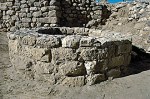
Photo of Beersheba by Leon Mauldin

Photo of Beersheba by Leon Mauldin

The making of oaths and treaties in ancient times was far more serious than it is today. When anyone swore an oath and broke it, the penalty was severe, even death. I cannot help but wonder how different our world would be if promises and vows had more significance. Not unlike Bonhoeffer’s “cheap grace,” we now have vows made with fingers crossed behind our backs.

Genesis 21:30-31
He replied, “Accept these seven lambs from my hand as a witness that I dug this well.” So that place was called Beersheba,because the two men swore an oath there.

Lack of trust is at pandemic proportions, the real core to our inability to make a vow or promise and keep it. We have all been betrayed so many times, we do not believe the word of others. Either we need lots of evidence or the cost for breaking trust must be so high that everyone is put in a fear position to uphold the agreement (hence, the Cold War).

Of course, those fear-based promises usually have loopholes and everyone is busy trying to find them.

Marriages have become the thing of mistrust and loopholes as well. I find it amusing, the angst over same-sex unions, while cheating, divorce, and secret lusts rage in society. How often are the ones who rail against the sins of others, forget their own?

A covenant is a binding oath, a promise that cannot be broken. An agreement with God, the acceptance of Christ as the Messiah, is on that level.

I forget this sometimes. I dishonor the agreement. I don’t hold up my end of the bargain, the treaty, the contract. In a secular world, if I broke a contract the number of times I have broken covenant with the Christ, I would be sued or forced to pay large sums of money or put in jail. But my contract, thanks be to God, is with Grace. And I get more chances to make it right.

I give “lip service” to my trust in God, but I’m afraid I don’t build my foundation on it. I am swayed and battered by the storms of life and I lose sight of trust I promised to have in God. I know intellectually that God is faithful and trustworthy, but still I stumble.

Sensitize me to Your Presence today Lord and give me courage to speak trust in the face of all circumstances. Help me build a Beersheba today, to remember my promise.

Read Full Post »

The mark of God. In that day, this command was a monumental request, an everlasting mark on the body that could not be reversed. No male would enter this covenant lightly. No God would ask it without cause. The offer God was making was a forever offer. And then what happened?

Genesis 17:11; 13b
You are to undergo circumcision, and it will be the sign of the covenant between me and you. . . . My covenant in your flesh is to be an everlasting covenant.

Certainly, in today’s western world, circumcision is no longer seen as a mark of God. For modern generations, it has been a norm, perhaps a health issue, but primarily, a cultural one. That is not to say that all cultures practice circumcision, they do not. But even where it is practiced, in the United States, for instance, it’s not at the command of God.

But then, the covenant that God made with Abraham (his name change happened at the same time), did not, ultimately, go forever as a mark from God anyway. With the coming of the Christ, the mark of God had evolved away from circumcision (this is confirmed by Paul, who extended the range of Christ-knowledge to the gentiles who had never been circumcised). The plan for the everlasting covenant altered.

Perhaps even back then, this mark of the flesh had lost its significance. I do not know. But clearly, by the time of Christ and thereafter, it was no longer required for the gentiles who accepted Christ. And, as we know, this mark was never intended for women, even then. They were covered by the marks on the men who “covered” them.

But Jesus began raising the value of women, they were treated with more importance. Jesus had conversations with women and taught them.

So, what is the new mark of Christ’s covenant on our flesh? None. The mark is within.

Have I allowed this mark to change me? Is my heart, like the circumcised flesh of men in Abraham’s time, transformed by it forever? Or, is it just cultural?

Wasn’t this the point all along? “The Lord your God will circumcise your hearts and the hearts of your descendants, so that you may love him with all your heart and with all your soul, and live.” [Deuteronomy 30:6]


Read Full Post »

Although Abram could believe that God would provide him with descendants as numerous as the stars, he questioned God’s ability to give him the land. Perhaps there were enough loopholes in the promise to make a baby, but land was solid; land was imperishable; land was enduring. And in this case, the land was occupied.

Genesis 15:7-8; 18a
He also said to him, “I am the Lord, who brought you out of Ur of the Chaldeans to give you this land to take possession of it.” But Abram said, “Sovereign Lord, how can I know that I will gain possession of it?” . . . On that day the Lord made a covenant with Abram and said, “To your descendants I give this land . . .

Whereas the baby was a promise, the land became the end result of a contract, a covenant. It was formal and branded with the blood of animals. When blood is spilled over a promise, then it is unbreakable.

In some ways, this sign is still with us today; we hear of it in other cultures like blood oaths and blood rituals. These are done with the same intent, a promise, a loyalty, a trust, are exchanged.

There are a number of blood covenants in scripture and of course, the most important one to believers and Jesus followers, is the blood of the Christ, the Messiah, spilled once for all.

The Israelites gained and lost the land through poor judgment and sin. All through the history, kings fought over the land and by the time of Solomon, it had been taken back and restored to the people of the promise, the people of the covenant. And yet, in not so many generations later, the land was lost again. Today’s Israel is still fighting, for good or not, I do not know, but it is in their DNA to pursue the land that was lost.

The Christ, the very Son of a Holy God, spilled blood as a substitute for our own blood in place of those conscripted animals who annually paid the price in times long past for the sins and bad choices of Human. But just as the Israelites lost their land, despite the promise, Human is loosing everlasting life through distraction, unbelief, division, and tunnel vision.

Too many times, we, Human, we act as though the covenant is failing or no longer powerful. But I know that is not so. I know this deep in my soul.

And so, forgive me Father, when I look elsewhere for the “solutions” to my problems, when I look elsewhere for direction, when I don’t look at all. Forgive me Covenant maker.

Read Full Post »

Painting by Frank Wesley

It was not a quick departure from the ark at all. Depending on the counting system one uses and the assumptions about the calendar, it was a good year that everyone was on the ark. A full year in a small space. A full year in which a whole set of norms were created. When the door opened, everything changed, again.

Genesis 8:15-16a; 9:6
Then God said to Noah,“Come out of the ark. . . . And for your lifeblood I will surely demand an accounting. I will demand an accounting from every animal. And from each human being, too, I will demand an accounting for the life of another human being.

The implication of a couple of verses seems to be that there was not a lot of animal eating on the ark. That makes sense since the there were a limited number of animals that could be there. Was the situation more like the exodus when shoes did not wear out and people survived on manna? Who knows. But one thing is clear, once they left the ark, Human was given, once again, full authority over all living creatures and could eat of them (as long as the lifeblood was not in them – a somewhat anti-vampire mandate).

But even more important, along with the promise (and subsequent covenant God makes with and to Human), God also announces a required  accounting from each and every living creature, including Human, on earth. In essence, if “you” (living thing) are going to live on this earth, if I (God) am going to give you a fresh start, then you have to report out on how you used this gift of life.

I wonder if I had a stronger sense of this in my own life if I would make different choices?

Instead of worrying about “not” sinning or avoiding “bad things,” wouldn’t it be better to be more conscious of the good use of time, the strong ROI of my investment of time, money, and energy.

They say that many people who have a near-death experience often view life differently from then on. And depending on their foundation, they either become lackadaisical (what’s the point) or they become keenly focused on making each day count. It is a question one hears, “What if you had x amount of days to live, how would you live differently? . . . or would you?

Becoming a follower Christ, is a little like coming out an ark. It, too, is a fresh start. As a new believer, it is so much easier to see and feel the renewal. But, as we grow older in the faith, I think we lose touch with the wonder and worse, we lose touch with our accounting.

I think it’s daily actually. It should be part of our prayer life. I would like to bring it into my own prayers, my evening prayers, my review of the day. Oh Lord, this is what I did with this day, your gift to me. Forgive the missteps; rejoice with me in your moments; and thanks for the grace when I was afraid.

Read Full Post »

Somehow I have had it my mind that God interrupted Noah while he was about his daily business and said, “I’ve got a job for you, go build an ark.” But now, I am caught up in this idea of people “walking with God” and what that means. I have assumed this walking with God business was a metaphor for closeness. Is that the only choice?

Genesis 9b; 13-14a
Noah was a righteous man, blameless among the people of his time, and he walked faithfully with God. . . So God said to Noah, “I am going to put an end to all people, for the earth is filled with violence because of them. I am surely going to destroy both them and the earth. So make yourself an ark. . . “

The only reason I’m playing around with this idea is that pre-flood, life was different. All the patriarchs were still around, their generations overlapping by hundreds of years. Even Adam was around for at least half of this time. The Garden experience was still part of their vernacular. And one of the most memorable things was Adam, Eve, and later, Enoch (my interpretation), walking with God in the Garden.

And here’s another one, Noah, specifically noted as walking with God.

In an article by Bob Sorge in Christianity Today, he writes, “God created man for the enjoyment of a walking relationship that involved companionship, dialogue, intimacy, joint decision-making, mutual delight, and shared dominion.”

I think that’s true, but I think we will never have the same opportunities as Human had before the flood. Despite being cast out of the Garden, God allowed for intimate relationships with others. God seems to always leave a loophole for Human, that’s how much God wants to ultimately preserve Human.

But it is a narrow way (Matthew 7:13). It is narrow because intimacy itself requires it. Even today, we cannot be intimate with everyone. Most people can only manage a few close friends, a few friends we trust totally, a few friends in whom we have invested our time, energy and even money. And sometimes, if we are lucky, we are married to one of these friends as well.

Noah built the ark because he was familiar with the God who told him to do it. He was not merely being “obedient,” they had probably talked about it already. Maybe there was an Abrahamic negotiation even (Genesis 18:16-33). We’ll never know.

All this makes more sense to me, that God doesn’t drop down edicts or demands or mandates on an unsuspecting follower. These requests come out of relationship, out of familiarity, and trust.

I remember, as a young Christian, I was so afraid that God would “call” me to some egregiously difficult post like the bush of Africa or the ice floes of Siberia or the rice paddies of China. But now I see, these directives come from internal agreement and possibly even a nurtured longing.

Come, Jesus says, walk with me.

Read Full Post »

Adam said it was the woman’s fault for giving him the fruit (and maybe a little bit God’s fault for giving the woman in the first place). Eve blamed the Serpent who deceived her. Interesting, though, the Serpent is silent.

Genesis 3:11b-13
Have you eaten from the tree that I commanded you not to eat from?”
The man said, “The woman you put here with me—she gave me some fruit from the tree, and I ate it.”
Then the Lord God said to the woman, “What is this you have done?”
The woman said, “The serpent deceived me, and I ate.”

I’m assuming the Serpent knew what was up from the beginning. He expected retribution. He had counted the cost. So, however he might have looked in the garden, the Serpent was ever changed, and most interesting, for whatever reason, the relationship between the Serpent and woman would be one of enmity. I find that fascinating. The implication is that the relationship could have been something else had everything gone the other way. But what?

What was the Serpent’s true nature? In the same way that Jesus brought Judas Iscariot into his sphere of influence, so did God bring the Serpent into the garden. There was opportunity for them to choose differently, to want something else, to be reached.

We are quick in this culture to lay blame as well. This week is election week. All media outlets from news programs to Facebook are afire with political mumbo-jumbo. And usually, it’s one side finding fault with the other, somehow thinking if enough aspersions are thrown out there, their own missteps will be ignored.

In reality, we have all eaten the fruit of the knowledge of good and evil and as a result, we spend far too much time looking at “not-God” instead of looking for what is good and right. The ancient aphorism speaks well here: Know Thyself. It’s so important to remember that our eyes are corrupted.

Open my eyes to see like you, to understand with Godly wisdom, to bring grace into every situation and conversation, to clearly bring myself to the situation. As a follower of Christ, I bring God to every table, to every discussion, to every contemplation. That’s part of the covenant I made.

I must accept blame for the part I play in my world.

Read Full Post »

« Newer Posts - Older Posts »