Feeds:
Posts
Comments

Posts Tagged ‘Jesus’

Art by Kelly Watts

Art by Kelly Watts

Apparently, there were several concentric circles of influence, courage, and power around King David. In I Chronicles 11, there are several references to both the three and the thirty. Unfortunately, they don’t exactly match up with sister references in II Samuel 23. (See Wikipedia article for details.) And yet, they are provocative in their specificity:

Jashobeam, a Hacmonite, was commander of the Thirty . . . Next in command came Eleazar, Dodo’s son the Ahohite, who was one of the three warriors. . . . Abishai, Joab’s brother, was chief of the Thirty. He raised his spear against the three hundred men he had slain, but he wasn’t considered one of the Three. He was the most famous of the Thirty. He became their commander, but he wasn’t among the Three. . . .  He [Benaiah] was famous among the Thirty, but didn’t become one of the Three. [I Chronicles 10b; 12; 20-21; 25]

These groups represent spheres of influence as well as strategies of leadership.They were predominately known to be mighty warriors.

Jesus also had spheres: the three closest disciples [Peter, James & John, so referenced in Mark 9:2] and of course, the twelve who became the core group, “first, Simon (who is called Peter) and his brother Andrew; James son of Zebedee, and his brother John;Philip and Bartholomew; Thomas and Matthew the tax collector; James son of Alphaeus, and Thaddaeus; Simon the Zealot and Judas Iscariot, who betrayed him” [Matthew 10:2-4] and lastly, the seventy or seventy-two, “After this the Lord appointed seventy-two others and sent them two by two ahead of him to every town and place where he was about to go [Luke 10:1].

In each case, these groups had particular assignments. In David’s case, they were warriors and commanders, built for strength, battle, and protection. They displayed courage and often risked their lives for their beloved King. They came to David gifted in these areas.

On the other hand, the disciples that Jesus selected seemed less than qualified. They came from different walks of life except for a sub-group of them who were identified as fisherman and one a tax collector. We don’t know much about the rest, but we do know they were not the normal supplicants who would follow a rabbi. Many stories, in fact, show some frustration on Jesus’s part at their ability to grasp his teachings and what his teachings meant. Essentially, the disciples did not really come into their own until Jesus commissioned them upon his resurrection.

In recent years, the phrase, “God doesn’t call the qualified, but qualifies the called” has become quite popular. And although that is true in some cases, like the New Testament disciples who learned by doing and following their Teacher, we also have the example of the Three and the Thirty who were already gifted and committed their gifts to the King. They gave what they had.

Both are needed: those who have talents can surrender them to God and those who don’t know what their talents might be can surrender their will to God and their use will evolve.

Read Full Post »

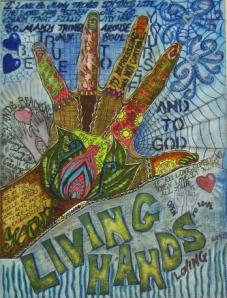
right handThe most common reference to “right hand” placement is the right hand of God and the One on this side, that is the Son of Man, the Messiah, Christ Jesus. This is a place of shared power and signifies authority. This norm has carried down through the ages to the point that most “guests of honor” at a dinner table are seated to the right of the host. It is a place of And yet, in Psalm 16, there is a new take on this idea:

I keep my eyes always on the Lord.
    With him at my right hand, I will not be shaken. [Psalm 16:8, NIV]

I am moved by this proclamation and realize it should be mine each day. With it, I could give authority to God to move on my behalf and with it I could count on God’s presence to protect me, to guide me, and to support me. In addition to giving God authority, if I could practice keeping my eyes on God, symbolically speaking of course, I could focus my energy and direction, cast off distractions and, potentially, move forward without fear. Oh, what prevents me?

I remember back in acting school when we were introduced to a variety of circus skills, my favorite was tightrope walking because of the visual concentration required, to keep the eyes looking ahead at a single destination point.

But I also remember the story of Peter who walked on water, albeit briefly, as long as he kept his eyes on Jesus. Did he try it again? I always wondered. Did he remember the experience as a success or a failure? He defied, for just a few steps, the laws of gravity and science. He stepped outside the known dimensions of reality. But was it enough to believe?

spiralBut here’s a conundrum:
“You will show me the path of life; in Your presence is fullness of joy, at Your right hand there are pleasures forevermore. [Psalm 16:11, Amplified]

And here, in the same psalm, I am now at God’s right hand, receiving the benefits thereof. An interesting circle: God at my right hand and me at God’s right hand: Oneness. That is the point. Fueling and being fueled, loving and being loved, giving and receiving, all at the same time. Strength to strength [Psalm 84:7].


Read Full Post »

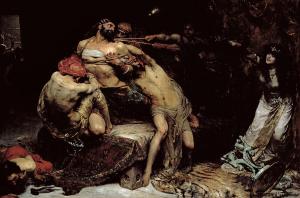
Painting by Solomon Joseph Solomon (1860-1927)

Painting by Solomon Joseph Solomon (1860-1927)

Samson had everything he needed to serve and lead. He was called from childhood, from the day he was born. He was a Nazirite: dedicated to God. But these gifts made him prideful. He lost sight of the true source of his strength.

“Samson fell in love with a woman named Delilah. The rulers of the Philistines confronted her and said to her, ‘Seduce him and find out what gives him such great strength and what we can do to overpower him.’ . . . “ [CEB, Judges 16:4-7a]

Did Samson make a mistake falling in love with the “wrong” woman? Apparently women were his weakness even more than his hair.

Delilah wasn’t the first time a woman betrayed him. Read Judges 14 where his Philistine wife [unnamed] beguiled him for the answer to a wedding riddle and told her relatives. That treachery ended badly with Samson taking revenge both in killing thirty random Philistine men and later destroying a number of his enemies’ fields and crops. The Philistines feared and hated Samson. And yet for the next twenty years, he continued to win victories with his strength alone.

Then Delilah, yet another Philistine woman, came into the picture. Her village elders offered her great sums of money for the secret of Samson’s strength. And so she double crossed Samson. Why couldn’t he see what she was doing? Why couldn’t he remember how it went the first time? Did he actually trust Delilah? I don’t think so. Pride consumed him. He could not imagine that God would allow him to be defeated. That lesson came hard when he was taken, blinded, and put to labor in prison, reduced to a stock animal grinding grain. He told Delilah the “secret” of his strength. But really, the secret was the hand of God. The hair was a symbol of the covenant.

Do I know the real secret? Or I have I fallen into Samson’s folly?

God has given us all gifts, strengths, and abilities. Certainly, God has given much to me but I take most of it for granted: my comfortable life, my health, my stage presence, my writing, my adopted children, my energy, my passion and enthusiasm, my long-standing marriage, my home, my job, my church; the list goes on and on. I am too comfortable I think. My gifts have become a norm like Samson’s long hair. As a result, I have lost my vision and gratitude for them and their purpose in my life.

Much will be demanded from everyone who has been given much, and from the one who has been entrusted with much, even more will be asked.” [Luke 12:48b]

Art by Cheryl Ward

Art by Cheryl Ward

Forgive me O God, for I have sinned in my plenty, fearful of less, but holding on too tightly to the cornucopia.

I remember, back in the high days of the Toronto Blessing (1994) when people were “catching the fire” and manifesting all kinds of strange behaviors (of course, lives were changed as well – I have no bone to pick with that revival experience), one of the popular phrases/prayers was to say, “more” Lord. They were asking for more of God, I know, but looking back, it also feels a bit narcissistic: give “me” more, touch my life, etc.  I suppose the ideal would be that God would give me more so that I might give others more. But I don’t see myself following through on such an arrangement. At least, not so far. There was a time I longed to be used of God in some miraculous way, as a conduit for healing or prophesying or wisdom . But I’m thinking, for the few who gained great popularity in those arenas, most of them went the way of Samson. With great power comes great temptation.

No, I don’t want that either.

I just want to be true to the Presence of God in me, to hold my hands and heart open, to speak truth, to forgive freely, to look and listen without comparing people to myself or to one another, to accept now with gratitude and pray for tomorrow with confident anticipation because God is sovereign. I don’t need to wait for my hair to grow long or my days to number into the seventies or eighties. Samson didn’t need to wait either. It just took him that long to figure it out.

Let this reveal have legs, Lord, and roots. Nourish my soul with your Breath. Today and always.


Read Full Post »

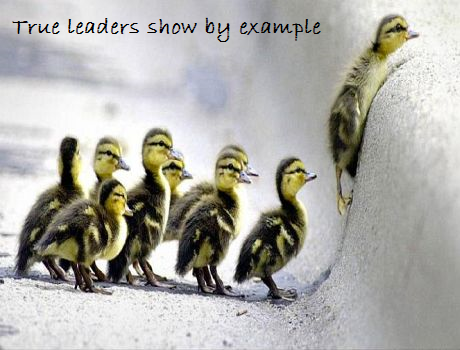
lead by exampleIs this cultural or simply part of human DNA? We seem to continually repeat our mistakes over and over again. And unfortunately, I see this both on a national and international level as well as in my own micro-world.

When that whole generation had passed away, another generation came after them who didn’t know the Lord or the things that he had done for Israel. . . . [And] then when the leader died, they would once again act in ways that weren’t as good as their ancestors’, going after other gods, to serve them and to worship them. They wouldn’t drop their bad practices or hardheaded ways. [Judges 2:10, 19, CEB]

The learnings from one generation to another are not happening. Parents are not telling or did not tell their children about the work of God in their lives in an authentic way; instead, they pass this job to Sunday Schools and Vacation Bible Weeks. In my mind, not only do we fail to tell the Bible stories, we a) water them down to make them PG and b) we don’t personalize them. Every story has a message for humanity. Every story has a message for me and my family. The Bible is not Disney World.

Miracles require effort and devotion, faith and trust. They require accessibility and openness.

I know some people have disagreed with me about telling our children about my past, particularly the darker side, but I have always felt  it was important for them to know that I am a different person today because of my faith, and that essentially, my lifestyle before Christ would have led very quickly to illness and death.

But I also think about our church and how we depend so heavily on our charismatic pastor and we are not raising up leaders to serve with him so that we don’t follow the footsteps of the Israelites who only succeeded while a particular leader was in place. It is everyone’s responsibility to tell the story, to walk the walk, to lead and train and grow. As the pastor tells his story, we must also tell our own.

authenticityOne of the ways to do this is mentoring (or discipleship). I have generally avoided this practice because it sounds so daunting, to take on a tenderfoot on the journey, to help someone else grow, to embrace him/her as family. I’m already struggling with my own adult children after all, how can I take on another, and what if I fail? But here’s the truth: all I have to do is “bring them along” when I go and do. I can’t pretend to be more than I am (nor should I assume I am less). New believers learn by being around old believers. New leaders step up when they watch old leaders in every day life, every day challenges, every day decisions, every day blunders.

Jesus didn’t turn on the leadership persona or the faith role just when the disciples were around. He lived and breathed what he knew. He healed because he could. He told stories because they meant something to him. He expressed mercy and grace because that was part of his genetic code.

We do not have to be infallible to demonstrate love and grace. In fact, authenticity goes farther. Mistakes confessed give hope to those who believe they are not worthy or that they are “too late” to change or that they can’t change. Our frailty revealed is courage demonstrated.

Generations ahead are depending on us now.


Read Full Post »

promises of GodJust a quick look in Google yields a number of websites people have created to lay out a full list of the promises of Christ, primarily based on things Jesus said, such as John 15:5, “I am the vine; you are the branches. Whoever abides in me and I in him, he it is that bears much fruit, for apart from me you can do nothing.” [Of course, that verse seems to be a combination verse, a promise and a consequence. Or are they the same?]

Near the end of the book of Joshua, it is written,The Lord gave them rest on every side, just as he had sworn to their ancestors. Not one of their enemies withstood them; the Lord gave all their enemies into their hands. 45 Not one of all the Lord’s good promises to Israel failed; every one was fulfilled. [Joshua 21:44-45, NIV] Most of these promises dealt with the land and conquering the pagan peoples who lived in those lands. All was fulfilled in that time. But we know how the story goes; not long afterward, the people jettisoned the plan and the covenant once Joshua passed and the last of the generation that saw God’s miracle-working power from Egypt to the promised land.

We are no different.

The words are still out there for us to embrace. The promises are still real and concrete. But we hedge our way, like the story of Eve and serpent, we hear these words instead, “Did God really say . . . ?” [Genesis 3:1b] Really? Did God promise this or that? Did Jesus really mean . . . isn’t it more likely that . . . ” And on and on and on we go, further afield of the simplicity of the gospel, either making it too complicated or too simplistic and in both cases, opening a door for doubt and confusion.

Today, I read on Facebook of a woman who was struggling with someone who questioned the “race” of Jesus. Was he white? Was he black? And so on. Is this a worthwhile discussion? Does it do anything for our faith? Or, is it just a surface issue that bypasses the central truth? Also today, I attended a funeral of a 19 year old daughter of a family friend and my own adult daughter was surprised how the young woman in the coffin did not really resemble the girl she knew. I had to remind Lily, the body is but a shell and it is the Spirit that gives the human body dynamics and life. Hannah was no longer there.

Painting by Jonas Gerard

Painting by Jonas Gerard

So it is with all things of God. The promises of God may appear to be about outer things, land and so on, but in reality, they are about the inner truth, the inner person, the relationship between my “self” and the God who lives in us through Christ. God’s promises are about eternity and living outside and beyond the body, the truly promised land. The enemies we face are the challenges of 3-D life: sin and selfishness, distrust and fear, evil from without determined to destroy the good within.

If only we . . . well, I can’t speak for you . . . if only I could engage fully in the truth of the fulfilled promise. It’s all done, completed from the day of Joshua to the day of Jesus, also a Joshua, who fought for my salvation and won. It is finished.

Read Full Post »

freedomInteresting. In today’s world, how often does a person use as their defense, “I didn’t know” or “Nobody told me.” And as a result, they believe this lack of knowledge absolves them of the crime. You’d think we’d get over it. After all, the “I didn’t see the stop sign” defense does not work in court, nor does “I didn’t know the speed limit” prevent an officer from giving us a ticket. And yet, we still say it and claim it and believe it.

 If anyone commits a sin by violating the directives I have given you—even if he was unaware of it—once he realizes it, he bears the guilt and must still accept the consequences. [Leviticus 5:17, The Voice]

The law works differently than grace. The law is immutable and enduring. The law has not gone away because of grace, it still exists; it is only our relationship to the breaking of law that has changed through Christ. For this reason, “. . . all have sinned and fall short of the glory of God.” [Romans 3:23] Sin still exists. Intentional or unintentional, blatant or secret, repeated or isolated, sin happens. Mistakes happen.

mercy on meInitially, I wasn’t fond of the centuries old Jesus prayer: “Lord Jesus Christ, Son of God, have mercy on me, a sinner” because I didn’t see myself as a sinner. I saw myself as foolish perhaps or selfish, but honestly, it wasn’t like I had killed anyone. (Why killing seems to be norm for being a sinner, I don’t know, but most people who say this phrase, use that act as the litmus test.)

During Jesus’s ministry, he called his disciples to the highest plateau of faith by telling us to walk the paradox line: love enemies, go the second mile, enter through the narrow gate, turn the other cheek, and so forth. And then, he tops these off with the ultimate impossibility: “Be perfect as your Father in heaven is perfect!” [Matthew 5:48] What? Absurd. That’s inaccessible. No one can do that. No one can be even close to the perfection of God. And I can just imagine Jesus smiling: “Yep. That’s the point.” And apparently, anything less than perfect is sin.

Sin is part of life. But how do we respond to it? Do we yield to sin and its backlash (as they say, “Karma is a bitch”) or do we call on the power of the Cross of Christ to stand between? It is the point.

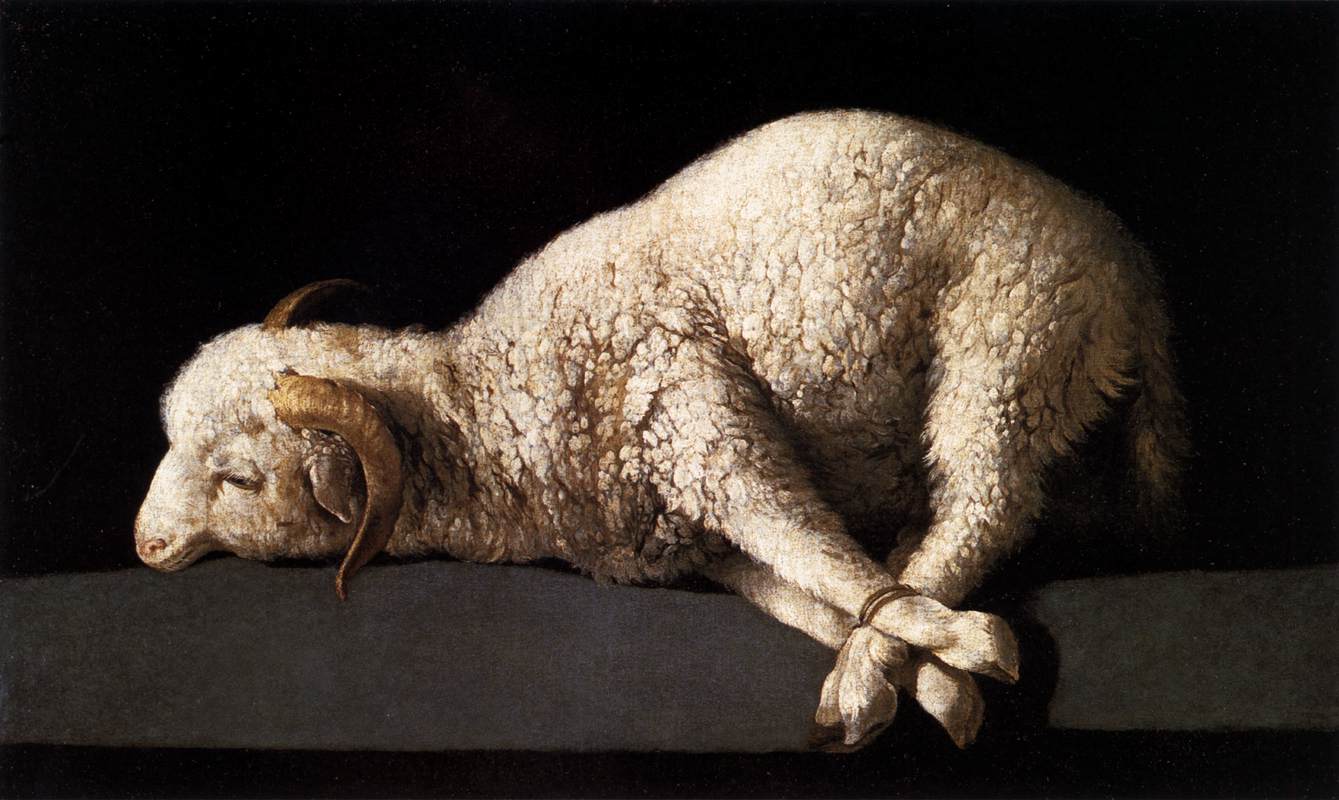
sacrificePeter writes, “Above all, love each other deeply, because love covers over a multitude of sins.” [I Peter 4:8] But Christ’s love covers ALL sins. We are encouraged to model our behaviors after Christ and practice love so that we can learn to be more generous of heart to one another. But there is only One who covers them all, from small to large.

Own up to the sin. But even better, own up to the sacrifice of blood that protects us all from the kismet of life’s choices.

Read Full Post »

ImpossibleIt’s been the word of the season at Restore Church this year: impossible. And it’s a word that all believers must hear, should hear, need to hear and understand. This word is about us today and our faith. This word is about the extent to which God will do something from nothing. Thanks Pastor Jess Bousa for this word, now illuminated.

It sounds impossible, but listen—you know your relative Elizabeth has been unable to bear children and is now far too old to be a mother. Yet she has become pregnant, as God willed it. Yes, in three months, she will have a son. So the impossible is possible with God. [Luke 1:36-37, The Voice]

The concept is a simple one, that the impossible cannot be expected: it is a miracle after all. And yet these miracles are among us every day but we fail to give them their due. Isn’t it a miracle that a man, like Jess, could be transformed from full-blown drug addict to pastor of a thriving church? Or that I, a self-indulgent, pot-smoking, foul-mouthed actress wannabe could become a follower of the Christ? Or that my children, all adopted, would be “the ones” out of a million orphans to come into our family? All of our lives are filled with the miracles of impossible when God takes the raw material of “nothing” and makes something. Whether one sees the Genesis story as word for word real or symbolic, the message is the same: Creator God is a Maker God, who uses building blocks that none of us can really fathom. Something from nothing. Possible from impossible.

In Greek, impossible is adynateō with meanings that bridge the distance between weakness, inability, and powerlessness to the bottom line: it cannot be done. And God asks me, when will I see and understand the adynateō in myself? Not weakness in what I want to do, my dreams and ambitions. No. This is the weakness in the face of what God wants to do. In Corinthians 12:9, God speaks through Paul saying, “My grace is sufficient for you, for my power is made perfect in weakness.” God is talking about the God Plan in Paul’s life and ultimately, in my life too.

God’s power manifests in doing God’s plan. 

impossible triangleOh, silly me. I have missed this obvious all along. I keep trying to get the blessing (and success) for my ideas, my plans, my ambitions, my projects. But there has been little room in my masterminding for the impossible, the unexpected, the miracles of God.

How many sermons and teachings have we heard about knowing God’s will for our lives, as though we might be able to figure out the impossible?

This is the only time I can truly say that the cliche, “whatever,” used by teens for the last decade or so, is truly the correct word in this situation. Our surrender to God is a “whatever.” That is, whatever God wants to do, whatever the Holy Spirit wants to manifest, whatever is possible in God’s cosmos, I choose to embrace today.

Don’t misunderstand me. I am sure this is not a passivity where we simply lie down on a bed and wait for a miracle. If anything, it’s a reckless abandonment of my narrow views in favor of the expansive potentialities of God.

Read Full Post »

« Newer Posts - Older Posts »