Feeds:
Posts
Comments

Posts Tagged ‘trust’

No.

Genesis 18:14-15
 Is anything too hard for the Lord? I will return to you at the appointed time next year, and Sarah will have a son.”Sarah was afraid, so she lied and said, “I did not laugh.” But he said, “Yes, you did laugh.”

Why did Sarah lie? It says straight out that she laughed to herself and doubted her old body could have a baby. And yet, when confronted by the visitor for laughing, she lied.

But then I knew. Her laugh said “I don’t believe.” And her fear came from another place, the place of hope, that it could true and did she blow it just then. Did she block the promise with her unbelief?

Fortunately, the measure of our faith does not drive the hand of God.

And yet, there is a measure since Jesus states several times [Luke 17:6, Matthew 17:20, and 21:20-21] that the smallest amount of faith can move mountains and fell fig trees. In other words, more can be done with faith. I could, with faith, participate in the transformation of the world. But that doesn’t mean it can’t happen without me. In fact, God’s will is what it is with me or without me.

I am invited into the realms of God; I am invited into fellowship of Spirit; I am invited to follow the Way that appears like paradox to me. I am invited to the banquet. [Matthew 22:1-14]

And if I say no to this invitation, the amazing truth is that God will invite me again, like the prodigal son, there will a table. But will the table be the same one, will it be the experience of moving mountains? Probably not.

I can laugh at God’s plan and God will forgive but I might be missing a miracle.

Read Full Post »

Despite the fact the Ishmael means “God hears” or “God listens,” the name has become symbolic for being cast out or cast aside. And, isn’t it fascinating that Abraham, the father/patriarch of nations, was also the father of the Arab nations as well as Israelites? If you think the Adam and Eve story caused havoc in Human, what about this one?

Genesis 16:11-12
The angel of the Lord also said to her [Hagar]: “You are now pregnant and you will give birth to a son. You shall name him Ishmael, for the Lord has heard of your misery. He will be a wild donkey of a man; his hand will be against everyone  and everyone’s hand against him, and he will live in hostility towardall his brothers.”

So here are the traits of a donkey [originally wild ass]: hard working (have been used for work over 5000 years); used as pack animals and able to carry large weight for long distances; associated with the idea of people living at or below subsistence levels [the animal of the poor]; they can live anywhere from 10 years to 50 years, depending on their lifestyle and owners; adaptable; solitary; a male donkey’s [jack] bray can be heard over long distances — as much as 3 kilometers; hear well; fight defensively and persistently; they can interbreed which accounts for mules [bred with a horse]; and above all, stubbornness.

The stubbornness of a donkey is based on self-preservation. If a donkey believes circumstances are dangerous, it will resist. Otherwise, donkeys are also known for being friendly, intelligent, playful, and willing to learn.

So, is this such a terrible comparison, to be called a donkey of a man? It wouldn’t have to be except that the dominance of stubbornness seems to prevail over all of the other things. And stubbornness in anyone is a recipe for disaster. In a way, both Abram and Sarai were also stubborn. For Abram, it was called faithfulness, his conviction that God would follow through on His promises.

For Sarai, her stubbornness came into play by taking circumstances into her own hands. She may have believed God as well, but she appears to have been a practical woman. She waited ten years for her “miracle” child and decided that was long enough. Abram did not exactly try to dissuade her either. Abram, like Adam, passed over any responsibility to his spouse. Even when things went awry and Hagar, elevated from mere handmaid to surrogate, began testing the waters of her authority; Abram cast the solution back on Sarai.

I have always aligned myself with Sarai. I have her tendencies. I have her stubbornness. Once I believe I have the the answer or the solution and the track has been laid, I walk it with a vengeance.

I remember standing at the end of the aisle (at 18) waiting to walk toward my first marriage. In that moment, I knew I was making a terrible mistake. But of course, the path had been laid, and so I walked it. We lasted five years, but in the end, I was too immature to handle it and unfortunately, another dream became my obsession and I pursued that one (to move to New York and acting school) with the same singleness of purpose.

Most of the time, I believe we [Human] err because of our sense of time.

Even today, my husband (of 30 years by the way), bemoaned a familiar truth: “everything I start to do always takes longer than I think it will, whether it’s editing a video or fixing a faucet.” So true. It is “time” itself that we try to manipulate. But “time” will not bend to our will. “Time” is God’s domain and His alone to metamorphose.

Here’s the short of it. I accept my stubbornness and realize there are occasions when that is useful (when it’s called persistence) and instances when it gets in the way. Now I want to know and practice the difference,  to remember that I cannot control the outcomes of every situation: to trust God’s time.

Mary Karr, in her memoir Lit, tells of a fellow AA goofball she asked about “God’s will.” How to know when to act. And his answer is so apropos, we wait and stay the course until God tells us to do something else.

Most of us bemoan not knowing or hearing God’s voice because we act before the time. Simple.

Read Full Post »

Although Abram could believe that God would provide him with descendants as numerous as the stars, he questioned God’s ability to give him the land. Perhaps there were enough loopholes in the promise to make a baby, but land was solid; land was imperishable; land was enduring. And in this case, the land was occupied.

Genesis 15:7-8; 18a
He also said to him, “I am the Lord, who brought you out of Ur of the Chaldeans to give you this land to take possession of it.” But Abram said, “Sovereign Lord, how can I know that I will gain possession of it?” . . . On that day the Lord made a covenant with Abram and said, “To your descendants I give this land . . .

Whereas the baby was a promise, the land became the end result of a contract, a covenant. It was formal and branded with the blood of animals. When blood is spilled over a promise, then it is unbreakable.

In some ways, this sign is still with us today; we hear of it in other cultures like blood oaths and blood rituals. These are done with the same intent, a promise, a loyalty, a trust, are exchanged.

There are a number of blood covenants in scripture and of course, the most important one to believers and Jesus followers, is the blood of the Christ, the Messiah, spilled once for all.

The Israelites gained and lost the land through poor judgment and sin. All through the history, kings fought over the land and by the time of Solomon, it had been taken back and restored to the people of the promise, the people of the covenant. And yet, in not so many generations later, the land was lost again. Today’s Israel is still fighting, for good or not, I do not know, but it is in their DNA to pursue the land that was lost.

The Christ, the very Son of a Holy God, spilled blood as a substitute for our own blood in place of those conscripted animals who annually paid the price in times long past for the sins and bad choices of Human. But just as the Israelites lost their land, despite the promise, Human is loosing everlasting life through distraction, unbelief, division, and tunnel vision.

Too many times, we, Human, we act as though the covenant is failing or no longer powerful. But I know that is not so. I know this deep in my soul.

And so, forgive me Father, when I look elsewhere for the “solutions” to my problems, when I look elsewhere for direction, when I don’t look at all. Forgive me Covenant maker.

Read Full Post »

No one knows for sure how long it took Noah to build the ark although time is very much a part of the story, whether it’s the 40 days and nights of rain and bubbling springs or the month, day, and year the deluge started, scripture emphasizes a specific timetable and the significance of the flood and the ark in human history.

Genesis 7:11; 13; 16b
In the six hundredth year of Noah’s life, on the seventeenth day of the second month—on that day all the springs of the great deep burst forth, and the floodgates of the heavens were opened. . . . On that very day Noah and his sons, Shem, Ham and Japheth, together with his wife and the wives of his three sons, entered the ark. . . . Then the Lord shut him in.

I am not going to put forth the logic or lack thereof for the flood as literal truth or symbolism. In either case, the story has been passed down to us for a reason, and I believe it is predominately to remind us that God will always protect at least a remnant of Human even in the face of complete destruction. For me, this is part of my faith walk, to believe in the faithfulness of God toward humanity and all living creatures on Earth as a whole.

Noah was not necessarily required to proclaim or warn the rest of the people on earth like Jonah was, to warn Nineveh (book of Jonah) of upcoming destruction. And yet, Noah was considered a righteous man who walked with God. He was known by the people, he had a reputation. And, undoubtedly, people noticed him building a very large structure. But, unlike the bible stories from Sunday School, there is no record that Noah and his family were mocked during this construction. More than likely, they were somewhat ignored or viewed as a curiosity. There is also no record of people pounding on the ark trying to get in, a scenario that gives everyone pause in the face of recent floods, hurricanes, and earthquakes.

This thread makes me think again about our disasters of the last ten years. It’s making people jumpy and anxious. As a result, many people all over the country (maybe the world) have become quite extreme about preparing for the end times or preparing for global war or preparing for natural disasters. They are building “fallout shelters” and laying up provisions. They are arming themselves. Are they privy to something we aren’t? Are they wise to prepare? Are they building an ark? And will we be the ones pounding on the doors? I don’t know.

It goes back to relationship with God. If there is to be a remnant, then God will will provide. Otherwise, I can only live in fear and angst. The story of Noah and the ark is about the preservation of life as much as it is the destruction of unrighteousness.

God shut the remnant in.

No matter how big the ark was or how many were inside, in the end, unless God shut the door, they would have perished as well.

Matthew 5:45b states, “He [God] causes his sun to rise on the evil and the good, and sends rain on the righteous and the unrighteous.” All are exposed to suffering and pain as well as joy and happiness. No one is exempt from the flood, not really. In the greater scheme of things, we cannot choose for ourselves who will escape cataclysm.

Unless the Lord builds the house,
the builders labor in vain.
Unless the Lord watches over the city,
the guards stand watch in vain. [Psalm 127:1]

Read Full Post »

Somehow I have had it my mind that God interrupted Noah while he was about his daily business and said, “I’ve got a job for you, go build an ark.” But now, I am caught up in this idea of people “walking with God” and what that means. I have assumed this walking with God business was a metaphor for closeness. Is that the only choice?

Genesis 9b; 13-14a
Noah was a righteous man, blameless among the people of his time, and he walked faithfully with God. . . So God said to Noah, “I am going to put an end to all people, for the earth is filled with violence because of them. I am surely going to destroy both them and the earth. So make yourself an ark. . . “

The only reason I’m playing around with this idea is that pre-flood, life was different. All the patriarchs were still around, their generations overlapping by hundreds of years. Even Adam was around for at least half of this time. The Garden experience was still part of their vernacular. And one of the most memorable things was Adam, Eve, and later, Enoch (my interpretation), walking with God in the Garden.

And here’s another one, Noah, specifically noted as walking with God.

In an article by Bob Sorge in Christianity Today, he writes, “God created man for the enjoyment of a walking relationship that involved companionship, dialogue, intimacy, joint decision-making, mutual delight, and shared dominion.”

I think that’s true, but I think we will never have the same opportunities as Human had before the flood. Despite being cast out of the Garden, God allowed for intimate relationships with others. God seems to always leave a loophole for Human, that’s how much God wants to ultimately preserve Human.

But it is a narrow way (Matthew 7:13). It is narrow because intimacy itself requires it. Even today, we cannot be intimate with everyone. Most people can only manage a few close friends, a few friends we trust totally, a few friends in whom we have invested our time, energy and even money. And sometimes, if we are lucky, we are married to one of these friends as well.

Noah built the ark because he was familiar with the God who told him to do it. He was not merely being “obedient,” they had probably talked about it already. Maybe there was an Abrahamic negotiation even (Genesis 18:16-33). We’ll never know.

All this makes more sense to me, that God doesn’t drop down edicts or demands or mandates on an unsuspecting follower. These requests come out of relationship, out of familiarity, and trust.

I remember, as a young Christian, I was so afraid that God would “call” me to some egregiously difficult post like the bush of Africa or the ice floes of Siberia or the rice paddies of China. But now I see, these directives come from internal agreement and possibly even a nurtured longing.

Come, Jesus says, walk with me.

Read Full Post »

Enoch was the baby of the Adam line. Unlike his forebears or those who lived after him up into their 800’s and 900’s, Enoch died at 365. Outrageous numbers, all of them. Nobody can live that long. But who can really say? Clearly, Human (Adam/Eve) was different than we are today. So, let’s assume it’s true, just for the heck of it. What is there to learn?

Genesis 5:23-24
Altogether, Enoch lived a total of 365 years. Enoch walked faithfully with God; then he was no more, because God took him away.

Enoch walked with God. Now, since God usually walked in the Garden of Eden and not out with the non-Garden folks, something tremendous had changed here. The story says Enoch walked with God 300 years, presumably all the years after the birth of his son, Mathusaleh (the grandfather of Noah, who, by tradition is said to have died 7 days prior to the flood, which allowed for the proper days of grieving — that piece of trivia comes from the studious rabbis back in the day).

Enoch is the only one of the line who did not die in the natural way. Each patriarch is written as having a specific time of death, along with the presumable birth year of his first-born son and the total number of years he lived after the birth; but then he died. Except Enoch.

Enoch disappeared. God took him away.

Now, if I had to imagine how life looked back then, I would presume that Adam and Eve set up house as close to the Garden borders as possible. Maybe they couldn’t even see the Garden, maybe it had a mysterious “fantasy-like” secret entrance (there is mention of flashing swords and cherubim) or maybe it was a daily reminder. In any case, I can’t imagine them going far. So they set up a community for several hundred years and and with several thousand people, assuming they all had similar fertility and longevity.

But everyone knew and heard about Enoch. After all those silent years without God, about 600 years, Enoch had a special relationship with God, with the Creator, with the Master of the Garden.

People knew about the Garden. Certainly, Adam must have talked about the garden and what it was like, the same way people talk about heaven, or the good old days, or the best vacation ever. When people struggle, they build hope from their memories of better times in the past. If it was good once, it could be good again.

But Enoch was doing it. He was hanging out with God. Either he managed to get into the Garden for his strolls, or he had a pure heart, was recognized by God and rewarded with access. We’ll never know.

But in some way, what Enoch shared with God, he passed to Methusaleh, even if by story alone. And Methusaleh passed to Lamech, who fathered Noah and blessed him proclaiming, “He [Noah] will comfort us in the labor and painful toil of our hands caused by the ground the Lord has cursed.” They believed there was a reason for Enoch’s relationship. They believed in a better tomorrow.

There was an anointing on Noah from the beginning, then. He wasn’t some Steve Carell (an unbelieving Evan Almighty called by God to build a modern-day ark). Noah had the benefit of Enoch’s faith and stories passed down through the generations. It made a difference. We should be telling our faith stories to our children. We should be remembering and keeping track of the blessings of God. They are milestones of faith for those to come.

I believe Enoch is still in the Garden, untouched by the temptation of the other tree, relishing in the Tree of Life.

Read Full Post »

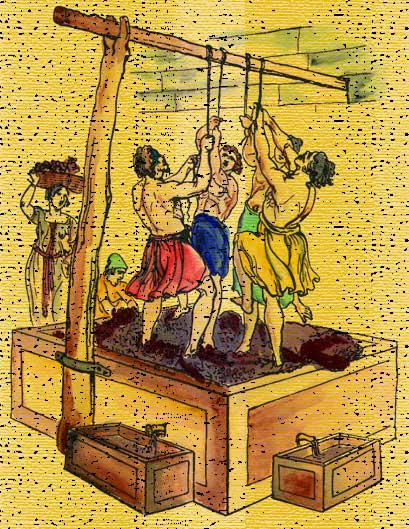
Throughout the Bible, the imagery of wine is used in a positive light, like Jesus turning water into wine or the Passover cup where it symbolizes the shedding of his own blood. But the winepress itself, the process, that pressure and transformation holds other implications.

Revelation 14:19
So the angel swung his scythe on the earth and stripped the grapes and gathered the vintage from the vines of the earth and cast it into the huge winepress of God’s indignation and wrath.
[Amplified]

It’s not a gentle business, the pressing of grapes, or for that matter, gathering them either. In the case of true wine making, there is a particular pressure applied to avoid smashing the seeds which give a more bitter flavor. Were they as concerned in ancient times? I don’t know since it was done with feet. In any case, once the grapes are smashed, they are no longer good as grapes. They must become something else.

Generally, I have only known the kinder forms of metamorphosis. The Holy Spirit is a gentle craftsman of my heart and soul. I am forgiven daily and given many, many opportunities to try again, to learn, to grow, to change and ultimately, to become a sweet aroma to both humankind and God. I want to translate myself into a creature of love and daring.

But I also understand that kicking against the goads of God’s will for me, fighting the process, forcing my way on the path, only makes it more difficult. And so, challenges and difficulties can arise to bring me back around.

It’s hard to see and understand the God way because it’s a way of mystery and paradox. It’s the path that Indiana Jones couldn’t see over the abyss. It cannot be seen or felt until one takes that step of faith. It’s not the golden chalice but the well-worn, humble one that is the Holy Grail.

Eventually, though, a day does come in the stretch of humankind when God allows the worst to happen. Like the pain of Job who lost everything to find everything, so it will be with Earth: a great shattering.

I don’t like the idea of contemplating such a turn of events nor do I want to be there. I don’t want to be there because of my own stubborn nature. I don’t want to know the winepress of wrath.

Read Full Post »

« Newer Posts - Older Posts »